Insurance Broker Automation: Workflows That Save Hours Every Week
You Know Where the Time Goes. The Question Is What You Are Going to Do About It.
Let's skip the part where I describe your week back to you. You know what it looks like. You built this agency, you know your producers, and you have probably spent more than a few evenings thinking about why the operation feels harder to run than it should.
The renewal stack that never gets shorter. The producer who is talented but perpetually behind. The follow-ups that fall through the cracks not because anyone dropped the ball intentionally, but because there are only so many hours and the administrative load keeps winning.
You have likely looked at technology solutions before. Maybe you bought one. Maybe it sits partially configured in a browser tab nobody opens anymore. If so, you are not alone, and it is not a reflection on your judgment. The insurance technology market is full of tools that were built by people who understand software but have never quoted a GL policy or explained a coverage gap to a nervous business owner.
This article is different in one specific way: it is written by people who have been on your side of the desk. We know what independent agency operations actually look like from the inside, and we know that the insurance broker automation conversation needs to start with your real problems, not a feature checklist.
So here is the honest version of that conversation.
The Real Problem Is Not That Your Producers Are Unproductive
Agency owners have a tendency to frame the time problem as a people problem. If the team were just a little more disciplined, a little better at prioritizing, a little faster at processing renewals, everything would run smoother.
That framing is understandable, but it is usually wrong.
The producers sitting in your agency right now are doing exactly what the system asks them to do. And the system asks them to do a staggering amount of work that has nothing to do with selling insurance or advising clients. Policy reviews that take ninety minutes because every carrier formats their documents differently. Renewal prep that requires pulling files, building summaries, and coordinating with account managers on accounts that were going to renew regardless. Quote comparisons done manually because no two carriers speak the same language. Follow-up cadences that depend entirely on individual producer memory and discipline.
This is not a people problem. It is an architecture problem. And it will not be solved by working harder or hiring another CSR. It will be solved by changing what your producers are asked to do manually in the first place.
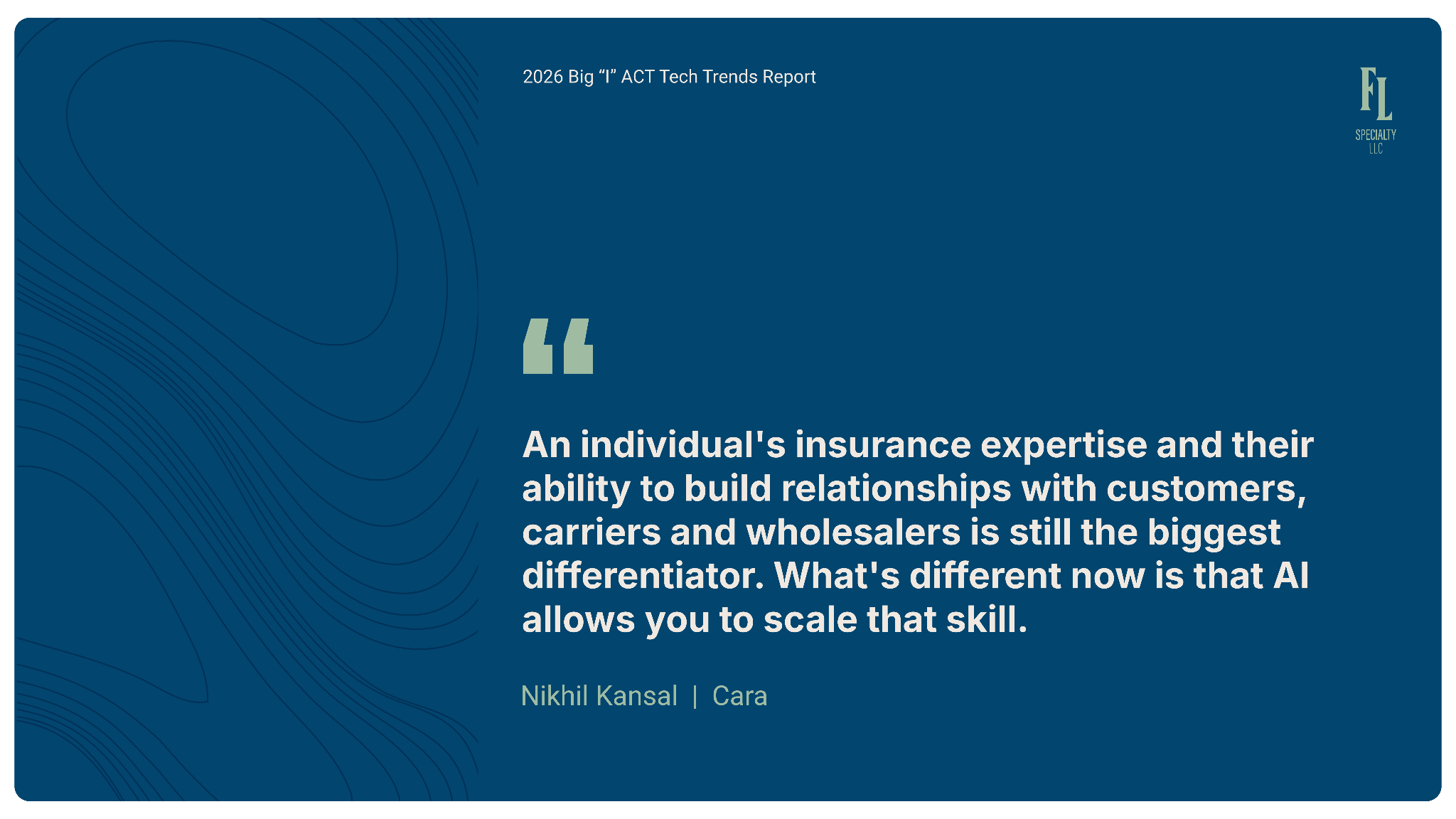
The 2026 Big "I" ACT Tech Trends Report puts the industry-wide version of this in plain numbers. Only 8% of independent agencies are using AI regularly and strategically. Sixty-eight percent say they plan to increase AI use in the next twelve months. The gap between intent and action is not skepticism about whether AI works. It is uncertainty about where to start and what to trust.
This article is an answer to that uncertainty.
Where the Hours Actually Go
Before talking about solutions, it is worth naming the problem specifically. Not in the abstract, but in the concrete daily workflows where independent agency time disappears. Because the fix has to match the actual problem, not a generalized version of it.
Policy Review and Coverage Comparison
A commercial policy review done right is not fast. Reading for coverage adequacy, identifying exclusions that matter, comparing a renewal against a competing quote from another carrier — these tasks require genuine expertise and focused attention. They also, for most agencies, happen entirely manually, on a timeline that is dictated by when the renewal lands rather than when the producer has bandwidth to give it proper attention.
The result is predictable. Reviews get rushed. Gaps get missed. Or the producer works evenings to stay on top of a renewal load that was not manageable during business hours. Neither outcome is acceptable, and neither is the agency owner's fault. It is the consequence of an architecture where skilled professionals are doing work that a well-designed tool could handle in a fraction of the time.
Renewal Season, Which Is All Seasons
There is a persistent myth in agency management that renewal season is a defined period. It is not. For an agency with any meaningful commercial book, renewal season is continuous. The renewal stack is always there, always building, always demanding attention.
The administrative component of renewal prep — gathering exposure data, flagging coverage changes, building stewardship summaries, coordinating between producers and account managers — is where the time goes. The strategic component, the actual client conversation, the coverage recommendation, the relationship work that determines whether the account renews or goes to market, is what gets compressed when the administrative burden expands.
Insurance broker automation does not eliminate the strategic component. It eliminates the assembly work that buries it.
Quote Assembly and the Carrier Translation Problem
Every carrier speaks a slightly different language. Coverages are described differently. Exclusions are formatted differently. ISO language gets modified, supplemented, replaced. A producer comparing three quotes on a commercial account is not just reading, they are translating, and the translation takes time that compounds across every account in the pipeline.
This is one of the highest-friction, lowest-judgment tasks in the agency workflow. It demands attention but not expertise. That combination is exactly what automation handles best.
Follow-Up That Depends on Memory
Ask yourself honestly: how many prospects are sitting in your pipeline right now that have not been touched in two weeks because someone meant to follow up and did not? How many renewals approached quietly because the 90-day alert fired but nobody had bandwidth to act on it in the window that mattered?
This is not about individual producer failure. It is about a follow-up system that depends on human memory and available bandwidth, both of which are finite. Automation makes follow-up a system function rather than a willpower function, and that changes everything about how consistently it happens.
The Insurance Broker Automation Workflows That Move the Needle
Not every insurance broker automation initiative is worth the effort. Some tools create new complexity in the process of eliminating old complexity, which is a net loss. The workflows below are the ones that deliver real time savings in real agency environments, without requiring a technology overhaul or a team of people to manage the implementation.
AI-Powered Policy Analysis
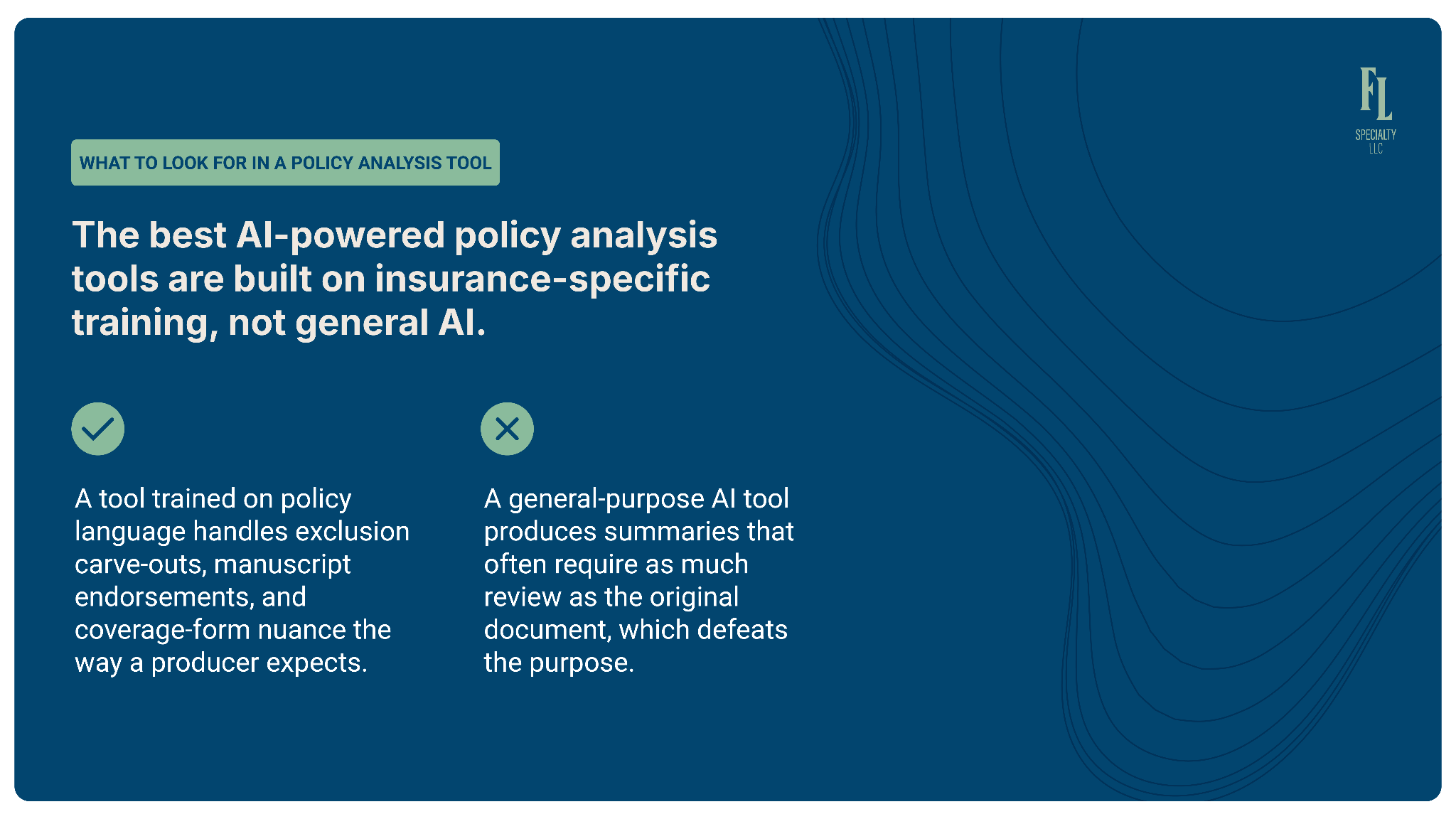
This is the one that tends to surprise agency owners the most, because the skepticism going in is usually high. Reading a policy is a nuanced task. How can a software tool do it reliably?
The honest answer is that it depends on the tool. The ones built specifically for insurance, trained on policy language rather than general text, can read a commercial policy and produce a structured summary — coverage limits, exclusions, endorsements, potential gaps — in a fraction of the time a producer takes to do the same work manually. An account that required ninety minutes of policy review now requires fifteen minutes of producer review of an AI-generated summary.
The producer is still in the loop. The producer makes the coverage judgment. The producer owns the client conversation. The difference is that they are walking into that conversation having reviewed a clean summary rather than having built it from scratch.
Renewal Workflow Automation
A well-designed renewal workflow does not wait for a producer to remember that something is coming up. It triggers automatically at a defined interval before expiration. It gathers the current exposure data. It flags what has changed since last renewal. It generates a draft renewal summary. And it puts that package in front of the producer ready for review, not ready to be built.
The producer's job at that point is judgment, not assembly. Review the output. Flag the two things that need a conversation. Make the call. The system handled the thirty-to-sixty minutes of prep work that used to precede that call.
Agencies that implement renewal automation consistently report two outcomes: more time per account for the relationship work that drives retention, and fewer accounts that fall through the cracks because the timing failed.
Quote Comparison That Normalizes Carrier Language
The carrier translation problem described earlier has a direct automation solution. AI tools built for insurance broker quoting can normalize multiple carrier quote outputs into a standardized format that puts the substantive differences in front of the producer, not the formatting differences.
The producer does not have to spend forty-five minutes reading three different documents in three different formats to understand that Carrier A has a broader professional liability definition than Carrier B but a narrower pollution exclusion. The tool surfaces those differences. The producer applies their expertise to what they mean for this specific client.
Proposal quality improves because the analysis is more thorough. Decision time drops because the comparison is cleaner. Client confidence in the recommendation increases because the producer can speak to what is actually different, not just what the premium numbers look like.
Automated Follow-Up That Does Not Depend on Bandwidth
This is the workflow change that tends to produce the most immediate visible impact on pipeline health. When a prospect quote goes out, a follow-up sequence initiates. When a renewal is approaching, a touchpoint schedule is triggered. The producer is notified when a human response is required. Between those moments, the system maintains the cadence.
The two prospects who went quiet last month and ended up choosing a competitor? In an automated agency, both of them received a follow-up sequence during the window where the decision was still open. One of them probably would have responded.
That is not a hypothetical. It is the consistent experience of agencies that move follow-up from a producer-memory function to a system function.
Documentation That Writes Itself
Coverage checklists. Binding confirmations. Carrier communication logs. Client disclosure documentation. These tasks follow predictable patterns, they are essential, and they are tedious. Templates exist for almost all of them. The work is repeatable.
Automating document generation for routine tasks eliminates one of the more persistent time drains in agency operations without meaningful risk, because the templates are reviewed and approved once rather than recreated for every account.
What a Week Actually Looks Like When Insurance Broker Automation Is Working
Here is the same agency, the same producer, the same book of business. The only difference is what the infrastructure is asking them to do manually.
Without Insurance Broker Automation
Monday. There are three renewals that need to be reviewed before client calls Tuesday morning. The producer pulls the policies, starts reading. The first one takes an hour because it has a manuscripted endorsement that needs careful review. The second one is interrupted by two service calls. The third gets pushed to Tuesday morning before the calls, which means it gets thirty minutes instead of ninety.
Two prospects who got quotes last week have not responded. The producer meant to follow up Friday. It did not happen. There is a note in the CRM that says "follow up" with no date attached.
Tuesday calls go well. One of the prospects calls in, not because of a follow-up, but because they have a deadline. The other two quote responses have gone to silence. Wednesday is mostly service work and a new submission that takes three hours because the carrier application format is unfamiliar.
By Friday, the week was not a failure. But the pipeline did not move the way it should have, and the producer is behind on two accounts that were supposed to be renewaled by end of month.
With Insurance Broker Automation
Monday morning. The three renewal summaries are already in the system. The AI policy analysis tool ran over the weekend. The producer reviews all three in forty-five minutes, flags two items that need discussion with the client, and moves to the rest of the day's work.
The two prospects received an automated follow-up Thursday. One responded. There is a call scheduled for Wednesday. The system flagged the other as unresponsive after two touchpoints, so the producer knows to make a personal call rather than wait.
The new submission on Wednesday takes an hour and a half instead of three hours because the quote comparison tool normalized the carrier outputs before the producer sat down to review them.
By Friday, the producer has two hours that were not available the previous week. They used one to make three calls to accounts that are up for renewal in sixty days. Those calls would not have happened in the previous version of the week.
Over a year, that margin compounds into a fundamentally different agency.
What to Look For, and What to Be Skeptical Of
You are right to be skeptical of insurance broker automation tools. The market is full of software that looks impressive in a demo environment and underperforms against real accounts with real complexity. Here is a practical framework for separating the tools worth evaluating from the ones worth passing on.
The Questions That Matter for Insurance Broker Automation
Ask every vendor the same three questions before you spend significant time in their demo environment.
Is this tool built for insurance, or configured for insurance? There is a meaningful difference. Tools built specifically for the insurance industry handle policy language, coverage terminology, and agency workflow structures without requiring customization. Generic tools that have been configured to handle insurance usually require ongoing maintenance to stay aligned with how your agency actually works.
Can I test it against my own accounts? Not demo accounts. Not sample data. Your actual policies, your actual pipeline, your actual client records. Any vendor who is reluctant to let you do this during an evaluation period is telling you something important about how the tool performs outside a controlled environment.
What does the E&O exposure look like on AI-generated policy summaries? This is the question that separates vendors who have thought seriously about how independent agencies work from vendors who have not. AI-generated coverage summaries that contain errors create E&O exposure. A good vendor has a clear answer about how the tool handles uncertainty, how it flags items that require producer review, and what the accuracy track record looks like on real policy documents.
What the ACT Report Says About Tool Adoption Failure
The 2026 Big "I" ACT Tech Trends Report is candid about why agencies buy technology and then fail to use it. The finding is not that agencies lack discipline. It is that they are exhausted by disconnected systems and constant retraining. The average independent agency is managing too many platforms that do not communicate with each other, and each new tool added to that stack creates new friction even as it promises to reduce it.
The implication for your evaluation process is straightforward: the right insurance broker automation tool is one that integrates with the systems your team already uses rather than adding another environment they have to log into and maintain. If the tool requires your producers to change how they record information, where they record it, or what systems they access during their normal workday, adoption will be partial at best.
Insurance-native design is not a marketing phrase. It means your producers work in familiar concepts from day one: lines of business, policy stages, premium data, client records formatted the way they expect them to look. That reduces the retraining burden. And reducing the retraining burden is what determines whether the tool actually gets used.
This Is the Decision That Compounds
There are decisions in agency management that have limited long-term consequences. Changing office supplies vendors. Picking a different conference to attend. Moving to a slightly different commission tracking spreadsheet.
Insurance broker automation infrastructure is not one of those decisions. The agencies that are building real competitive advantages right now are doing it by reclaiming producer time at scale and directing that time toward the relationship and advisory work that drives retention and new business. The agencies that are not making this move are subsidizing the advantage the automated ones are building.
The ACT report's most actionable finding is simple: 68% of agencies plan to increase AI use in the next twelve months, but only 8% are doing it today. That gap is the window. It will not stay open indefinitely.
You do not have to automate everything at once. You do not have to bet the agency on a platform you have not tested. But picking one workflow, the one that is costing your producers the most time right now, and solving it with a purpose-built tool is a start that compounds.
Your producers are good at this business. The question is how much of their week they can spend doing it.
About Fall Line Specialty
Fall Line Specialty is a Virginia-based specialty insurance firm where deep underwriting and data and analytics expertise meets AI. We deliver innovative underwriting and operational transformation services that help insurers, brokers, and agencies modernize their operations, capture new market opportunities, and navigate an ever-changing industry with confidence.
With decades of experience our team brings the hands-on expertise and forward-thinking technology partnerships that today's insurance organizations need to compete and grow. Fall Line Specialty is your guide through the future of insurance — smarter services, better outcomes, and solutions built for what's next.