How to Evaluate Insurance Agency Automation Tools: A 7-Step Framework
Key takeaways
- 01 The biggest mistake agencies make is starting with vendor demos instead of their own workflow pain points — if a tool doesn't solve a real problem, it doesn't matter how good the demo looks.
- 02 Many platforms marketed as automation still require significant manual upkeep. That's not automation — it's administrative reshuffling. Lean teams need leverage, not more maintenance.
- 03 Policy review depth is where most tools fall short — and where the highest-value gains are. If a platform can't help your team review coverage faster and more intelligently, it won't create strategic value.
- 04 Auditability is the most overlooked evaluation criteria — the right tool improves E&O defensibility by creating a consistent, documented record of coverage recommendations and client decisions.
- 05 A 9-week pilot beats a buying decision based on demo polish. Define your baseline in week one, run a controlled pilot, and make the call based on actual workflow results — not promises.
There is no shortage of software promising to improve agency operations. But for most independent agencies, the challenge is not a lack of tools — it is figuring out which tools will actually improve how the business runs.
That is why evaluating insurance agency automation the right way matters.
The wrong platform can create more complexity, more training burden, and more operational friction. The right platform can help a lean team save time, improve policy review, strengthen servicing workflows, and scale more intelligently.
For agencies evaluating insurance automation tools in 2026, the goal should not be to buy more software. The goal should be to build a better operating model.
Step 1: Define Your Operational Problem Before Looking at Any Tools
One of the most common mistakes agencies make when evaluating insurance agency automation is starting with vendor features instead of internal workflow pain points.
A platform may look impressive in a demo and still fail to solve the real problems inside your agency.
Before evaluating any tool, define what is actually slowing your team down today.
For most lean agencies, the biggest friction points are things like:
too much time spent searching for policy information
inconsistent or incomplete coverage reviews
renewals becoming reactive instead of strategic
too much manual review across policy documents
limited visibility into the client’s overall insurance program
poor documentation of coverage recommendations and client decisions
If a platform does not directly solve one or more of those issues, it is probably not worth your attention.
Insurance agency automation should solve real workflow problems — not just add another dashboard.
Step 2: Evaluate Time to Value, Not Just Features
Lean agencies do not have the luxury of six-month implementation projects that absorb staff energy before producing any measurable return.
One of the most important questions when evaluating insurance agency automation software is:
How quickly will this create real value for our team?
A strong solution should help your team see practical benefit quickly, especially in areas like:
policy lookups
coverage review
renewal preparation
account servicing
documentation consistency
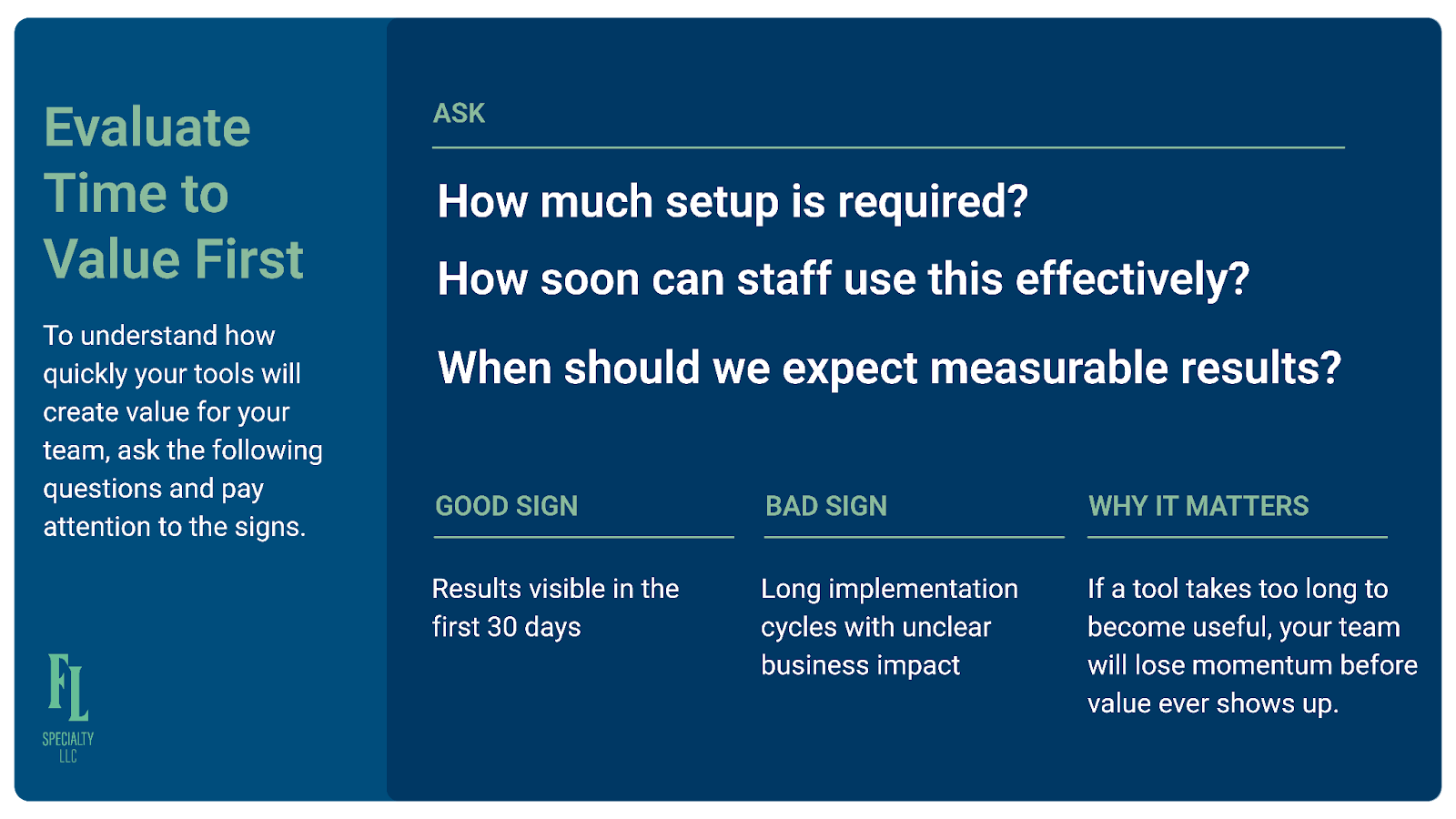
Before your first vendor demo, ask these three questions:
How much setup is required?
How soon can staff use this effectively?
When should we expect measurable results?
Good sign:
Results visible in the first 30 days
Warning sign:
Long implementation cycles with unclear business impact
Why it matters:
If a tool takes too long to become useful, your team will lose momentum before value ever shows up.
Step 3: Confirm It Actually Reduces Manual Work (Not Just Reorganizes It)
A surprising number of platforms marketed as insurance agency automation tools still require a significant amount of manual upkeep.
That might include:
ongoing data cleanup
repeated workflow management
excessive manual tagging or organization
duplicate entry into multiple systems
too much staff effort to keep the platform useful
That is not automation. That is administrative reshuffling.
The right insurance automation tools should reduce the amount of repetitive policy work your team performs every day — especially in areas like:
reviewing policy documents
comparing coverage details
preparing for renewals
answering client coverage questions
documenting advisory conversations
Ask:
What work does this actually eliminate?
What work does it still require from our team?
Will this reduce workload or simply reorganize it?
Why it matters:
Lean teams need leverage, not more maintenance.
Step 4: Test Policy Review Depth (This Is Where Most Tools Fall Short)
For many agencies, the highest-value use of insurance agency automation is not task management — it is improving how the agency reviews and understands coverage.
That means the evaluation process should go deeper than surface-level workflow features.
Ask whether the platform can meaningfully support:
policy intelligence
coverage gap analysis
multi-carrier coverage review
endorsement interpretation
renewal preparation
account-level coverage visibility
These are the functions that actually help agencies operate more intelligently.
If a platform cannot help your team review policies faster, compare coverage more effectively, or support better client conversations, then it may not create much strategic value at all.
What to ask vendors — Step 4 demo checklist
| Ask the vendor | Good answer looks like | Warning sign |
|---|---|---|
| Can you show me a live policy review — not a pre-built demo? | They upload a real document and walk through it in real time | They redirect to a scripted walkthrough or recorded video |
| How does the platform handle coverage gaps or missing endorsements? | Clear, specific examples of flagged gaps with context | Vague answer about "AI-powered insights" with no specifics |
| Can it compare coverage across multiple carriers in a single view? | Side-by-side comparison with clear field mapping | Requires manual export or separate tools to compare |
| How does it handle endorsements and policy exceptions? | Endorsements are parsed and surfaced alongside base policy terms | Endorsements require manual review outside the platform |
| How does the platform support renewal prep specifically? | Structured renewal workflow with timelines, flags, and client-ready output | Generic task management with no insurance-specific renewal logic |
| Can it give my team account-level visibility across an entire book? | Dashboard or view showing coverage status across all accounts | Account view is limited to one policy or one carrier at a time |
| How does it document what was reviewed and recommended? | Automatic documentation trail tied to client account and date | Documentation is manual or requires exporting to another system |
Why it matters:
The agencies that stand out in 2026 will not just be more organized. They will be better at interpreting and applying insurance knowledge at scale.
Step 5: Check Auditability and E&O Documentation Support
This is one of the most overlooked evaluation criteria — and one of the most important.
A strong insurance agency automation solution should not only help agencies work faster. It should also help them work in a more defensible and auditable way.
That includes the ability to better support documentation around:
coverage recommendations presented to the client
optional coverages offered
renewal discussions
client declinations or coverage decisions
internal rationale behind advisory recommendations
In many agencies, these records are inconsistent, buried in email threads, or not documented clearly enough to support defensibility later.
That creates both operational and E&O risk.
Ask:
Does this platform improve how we document our advice?
Can it help support a more consistent record of client offers and decisions?
Will it strengthen our audit trail over time?
Why it matters:
Efficiency is valuable. But efficiency combined with defensibility is far more powerful.
Step 6: Measure ROI Using Agency Metrics, Not Generic Software Benchmarks
When evaluating insurance agency automation tools, avoid vague promises like:
“improved productivity”
“greater efficiency”
“better workflow visibility”
Those phrases are not wrong — but they are not specific enough to evaluate real return.
Instead, measure potential value using agency-specific metrics such as:
time per policy lookup
number of coverage reviews completed
renewal preparation time
account manager servicing capacity
policies managed per staff member
client response speed
documented advisory interactions
opportunities identified for account rounding or improved protection
These are the kinds of improvements that actually matter to agency leaders.
Why it matters:
If a platform cannot clearly improve meaningful agency performance metrics, it may not justify adoption.
Step 7: Pressure-Test for Scalability, Not Just Current Fit
Some tools solve today’s workflow pain but create tomorrow’s scalability problem.
That is why agencies should evaluate insurance automation tools not just for current usability, but for future fit.
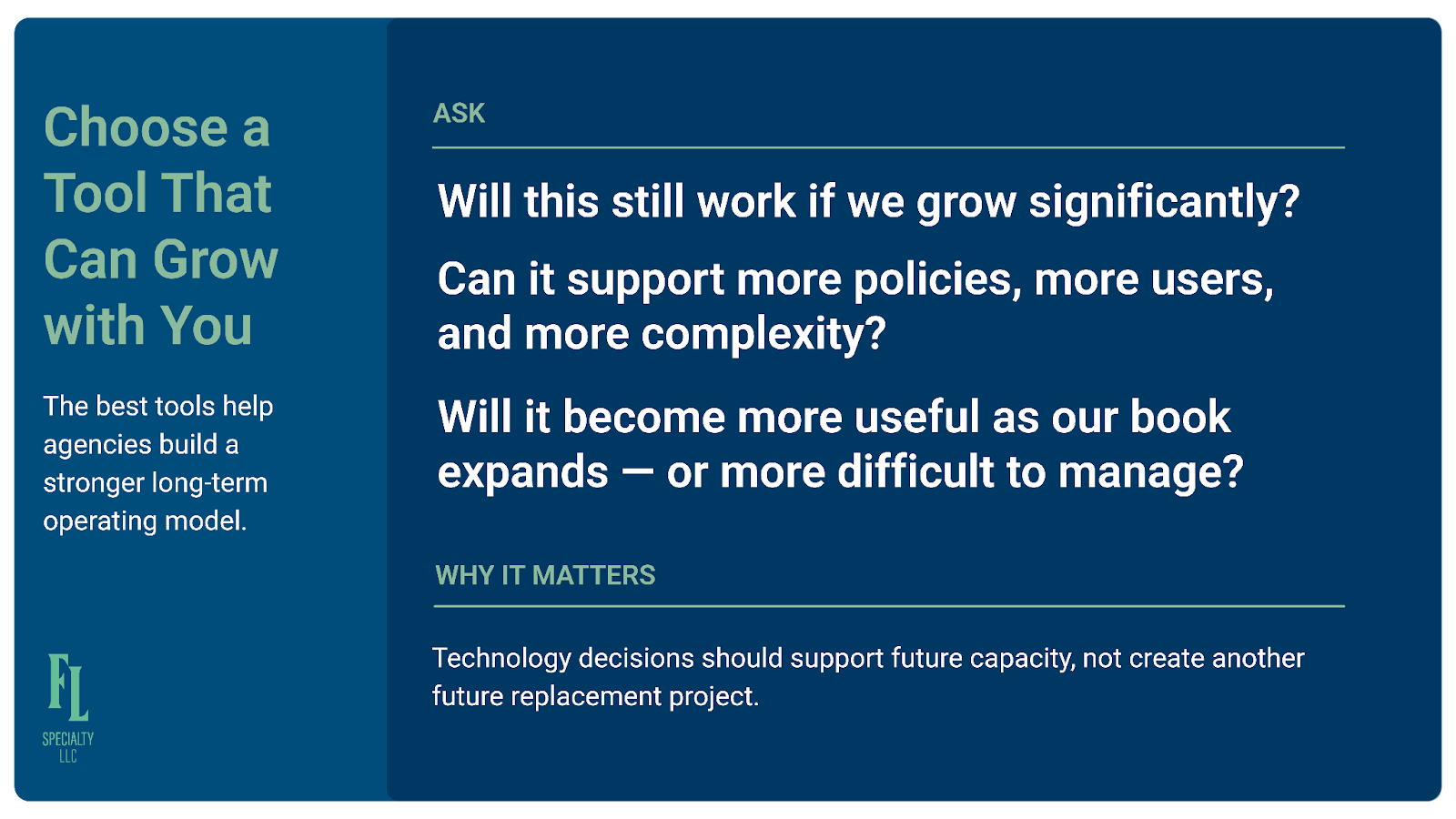
Ask:
Will this still work if we grow significantly?
Can it support more policies, more users, and more complexity?
Will it become more useful as our book expands — or more difficult to manage?
The best tools help agencies build a stronger long-term operating model, not just patch a short-term process issue.
Why it matters:
Technology decisions should support future capacity, not create another future replacement project.
A Practical Framework for Evaluating Insurance Automation Tools
For lean agencies, a strong evaluation process usually looks like this:
Week 1: Establish the Baseline
Track current operational friction points such as:
time spent locating policy details
number of coverage reviews completed
renewal workflow delays
servicing bottlenecks
documentation gaps
Week 2: Evaluate 2–3 Platforms
Compare tools using the same decision criteria:
time to value
reduction of manual work
policy review support
documentation strength
scalability
measurable ROI
Week 3: Select a Pilot Use Case
Choose one meaningful use case, such as:
policy intelligence
multi-carrier coverage review
renewal workflow support
documentation consistency
Week 4–8: Run a Controlled Pilot
Use a defined sample of accounts or policies and track measurable workflow improvement.
Week 9: Make the Decision
Review actual results based on:
operational efficiency
staff usability
business impact
quality of documentation
confidence in broader rollout
This creates a far more grounded decision than buying based on demo polish alone.
What the Best Insurance Agency Automation Platforms Should Deliver
The right insurance agency automation platform should help your agency:
retrieve policy information faster
review coverage more intelligently
improve renewal readiness
support multi-carrier coverage review
strengthen documentation and auditability
give lean teams more operational leverage
If it does not improve how your agency actually works, it is probably not the right tool.
Frequently Asked Questions About Insurance Automation Tools
How do I choose the best insurance automation tools?
Start by identifying your agency’s biggest workflow bottlenecks, then evaluate tools based on how well they reduce manual work, improve policy review, and support operational efficiency.
What should insurance agencies automate first?
Most agencies should start with high-impact use cases such as policy intelligence, coverage review, renewal preparation, or documentation consistency.
What should I look for in insurance agency automation software?
Look for fast time-to-value, reduced manual work, strong policy review capabilities, documentation support, and scalability as your agency grows.
Can insurance automation tools improve E&O defensibility?
Yes. The right tools can help agencies better document coverage recommendations, client decisions, and advisory conversations, improving consistency and auditability over time.
How do insurance automation tools help lean teams?
It helps lean teams reduce repetitive work, improve servicing workflows, and operate more strategically without immediately needing to add staff.
Choosing the Right Insurance Automation Tools for Agencies Matters
The best insurance agency automation decisions are not really about software. They are about building a stronger, smarter, more scalable agency.
For lean teams, the right tool can create meaningful leverage across:
policy review
client servicing
renewals
documentation
and account strategy
That is what matters most.
The agencies that evaluate insurance automation tools thoughtfully today will be the ones better positioned to operate with more speed, consistency, and confidence tomorrow.
Continue the conversation
Working through an automation evaluation right now?
Michelle writes on agency operations, automation strategy, and building smarter workflows for lean insurance teams. Connect on LinkedIn to follow along or start a conversation.
Connect with Michelle on LinkedInRelated reading
Automation Strategy
AI for Insurance Brokers: What to Automate (and What Not To)
Not sure where to start? This breaks down which workflows are worth automating first — and where human judgment still needs to lead.
Underwriting Strategy
The Insurance Underwriting Process Gap That's Costing You Broker Relationships
How automation connects to the bigger execution alignment challenge — and why tools alone don't close the gap.
Portfolio Management
Insurance Portfolio Management: The Clarity Risk Nobody Talks About
How the clarity problem scales when you're managing a full book — and why system-level data isn't enough.