AI for Insurance Agencies: 5 Ways Agencies Are Using AI Today
AI for insurance agencies is quickly moving from a buzzword to a real operational advantage. For lean teams, the question is not how many tools you have — it is whether those tools actually improve how the agency operates.
That is where insurance agency automation becomes more than a technology conversation. It becomes an operational strategy.
The best insurance agency automation tools in 2026 do not just digitize tasks. They reduce the manual work that slows teams down, improve the quality of coverage review, and help agencies deliver more proactive service without adding unnecessary complexity.
For agencies trying to grow with lean teams, these are the five capabilities that matter most.
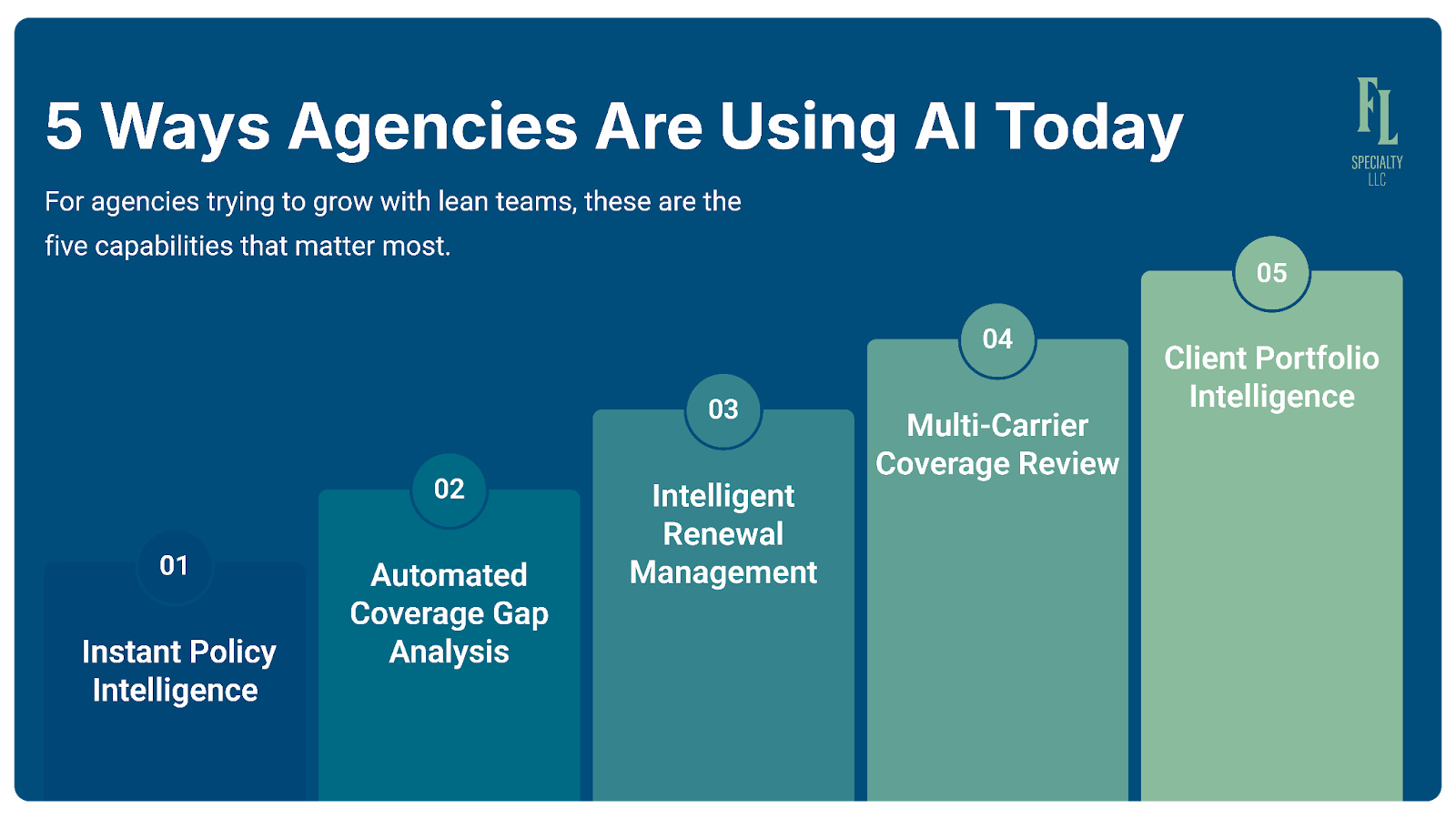
1. Instant Policy Intelligence
One of the biggest hidden inefficiencies inside an agency is the time spent looking for information that already exists inside policy documents.
A common workflow still looks like this:
log into a carrier portal
locate the policy
download the PDF
search for a specific endorsement or coverage term
manually confirm the answer
That may only take 10–15 minutes each time, but across a book of business, it becomes a major operational burden.
Insurance agency automation should eliminate that friction.
Policy intelligence AI for insurance agencies extract and structure policy information so agency staff can search once and find answers quickly.
Why it matters:
Lean teams should not have to waste valuable time retrieving information that should already be immediately accessible.
2. Automated Coverage Gap Analysis
One of the most valuable things an agency can do for a client is identify where their coverage may be incomplete, misaligned, or insufficient.
The challenge is that traditional coverage review is labor-intensive. It often requires manually comparing forms, endorsements, limits, exclusions, and policy intent across multiple documents.
That is exactly where insurance agency automation creates leverage.
Modern automation can help agencies surface:
missing or insufficient coverage
inconsistent limits
overlapping protection
potential rounding opportunities
key renewal discussion points
This allows agencies to move from reactive servicing to more strategic advisory work.
Why it matters:
Coverage reviews should not only happen when a client asks a question or when a claim exposes a problem. AI for insurance agencies helps to identify issues earlier and more consistently.
3. Intelligent Renewal Management
AI for insurance agencies is especially valuable in renewal managemet— and is one of the easiest places for agencies to lose control when workflows are too manual.
Without strong systems in place, many lean teams end up handling renewals reactively:
too late in the cycle
without enough time for thoughtful review
and without structured client outreach
Strong insurance agency automation improves this process by helping agencies:
identify upcoming renewals earlier
prioritize accounts based on complexity or risk
flag potential coverage issues in advance
support a more intentional client engagement process
This creates more room for strategic review and better client conversations.
Why it matters:
Better renewal workflows improve retention, strengthen trust, and create more opportunity for advisory value.
4. Multi-Carrier Coverage Review
Reviewing policies across multiple carriers is one of the most powerful applications of AI for insurance agencies.
Every carrier structures documents differently. Coverage intent may be similar, but forms, endorsements, exclusions, and policy language can vary significantly.
That means even experienced agency teams often spend too much time trying to compare and interpret:
limits and sublimits
exclusions
endorsement wording
additional insured language
differences in policy structure or coverage scope
This is where insurance agency automation becomes especially powerful.
Multi-carrier coverage review allows agencies to evaluate and compare policy documents from different carriers more efficiently and consistently — without manually dissecting every form from scratch.
Importantly, this is not about aggregating carrier portals. It is about making policy review across multiple carriers faster, clearer, and more actionable.
Why it matters:
Lean teams need a better way to review a client’s overall insurance program without increasing manual analysis time every time a policy changes or a coverage question arises.
5. Client Portfolio Intelligence
Strong agencies do not just manage policies individually — they understand the client’s insurance program as a whole.
That becomes difficult when information is buried across documents, systems, and servicing workflows.
The right insurance agency automation platform should help agencies build a clearer picture of each client by surfacing:
relationships across policies
account-level exposure considerations
risk concentration areas
advisory opportunities
account priorities over time
This gives agencies a more strategic way to manage the account, rather than just servicing one policy at a time.
Why it matters:
Client portfolio intelligence helps agencies operate more like trusted advisors and less like transactional intermediaries.
What AI for Insurance Agencies Should Actually Deliver
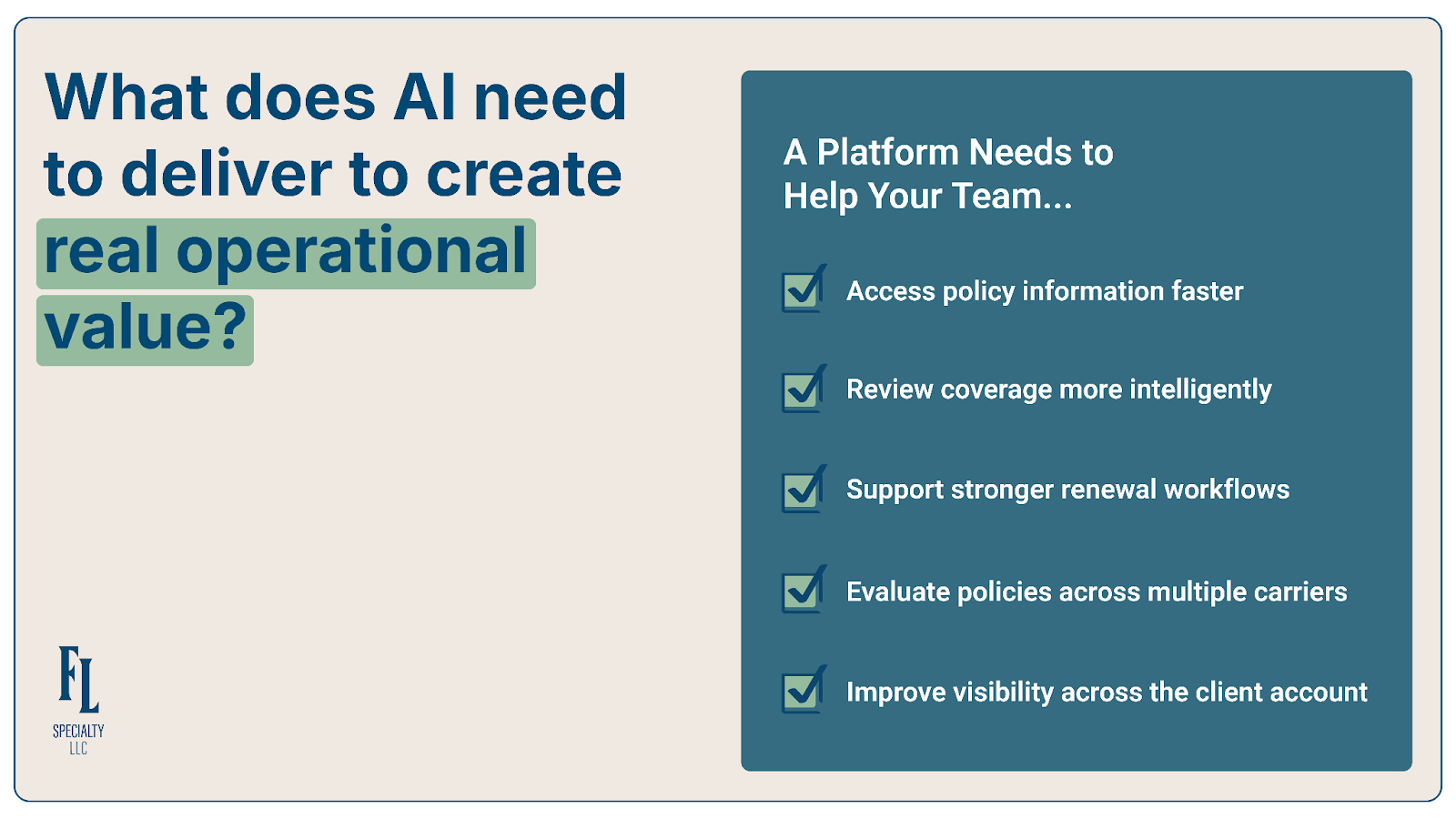
If a platform cannot help your team:
access policy information faster
review coverage more intelligently
support stronger renewal workflows
evaluate policies across multiple carriers
and improve visibility across the client account
then it is probably not solving a meaningful agency problem.
The best insurance agency automation tools should help your team become:
faster
more proactive
more consultative
more scalable
and more consistent
That is where real operational value is created.
Frequently Asked Questions About AI for Insurance Agencies
What are the most important insurance agency automation capabilities?
The most important capabilities include policy intelligence, automated coverage gap analysis, intelligent renewal management, multi-carrier coverage review, and client portfolio intelligence.
How does AI for insurance agencies help lean teams?
AI for insurance agencies helps lean teams reduce manual work, improve servicing speed, review coverage more efficiently, and create more capacity without immediately adding headcount.
What is multi-carrier coverage review?
Multi-carrier coverage review is the ability to review and compare policy documents from multiple insurance carriers more efficiently and consistently, especially when evaluating coverage scope, exclusions, endorsements, and limits.
Can AI for insurance agencies improve client service?
Yes. The best AI tools help agencies respond faster, identify issues earlier, support better renewal conversations, and deliver more proactive advisory service.
What should agencies look for in insurance agency automation software?
Agencies should look for software that improves policy review, reduces manual work, delivers fast time-to-value, and supports more strategic servicing and account management.
AI For Insurance Agencies Transforms Lean Teams
For lean agencies, the right insurance agency automation capabilities do more than save time. They improve how the agency thinks, advises, and operates.
That is what matters most.
The strongest agencies in 2026 will not simply be the ones with the most people or the most software. They will be the ones with the best leverage — and the clearest ability to turn expertise into scalable client value.
That is what modern insurance agency automation should deliver.
Ready to modernize your agency operations?
Fall Line Specialty helps insurance organizations work smarter through practical AI-enabled solutions built for the realities of agency operations. With Agency Sidekick, lean teams can improve policy review, strengthen documentation, and deliver more proactive client service at scale.
Talk to us to learn how Fall Line Specialty and Agency Sidekick can help your agency operate with greater speed, consistency, and confidence.