Independent Insurance Agency Automation: Why Lean Teams Can't Afford to Wait
Independent insurance agency automation is no longer optional — lean teams are competing against nationals and PE-backed platforms that have already automated the administrative layer, and the gap is widening. Clients expect faster service, better policy insight, and more proactive guidance — yet many agencies are still relying on manual workflows, disconnected systems, and too much staff time spent searching for answers instead of advising clients.
That gap is becoming harder to overcome.
Today’s independent insurance agency is under pressure from every direction: increasing client expectations, fragmented carrier systems, more complex commercial accounts, and a growing need to operate efficiently without adding headcount. For agencies with small or mid-sized teams, the traditional way of working is no longer sustainable.
The agencies that thrive in the next several years will not simply work harder. They will use insurance agency automation to multiply the effectiveness of the team they already have.
What Independent Insurance Agency Automation Means Today
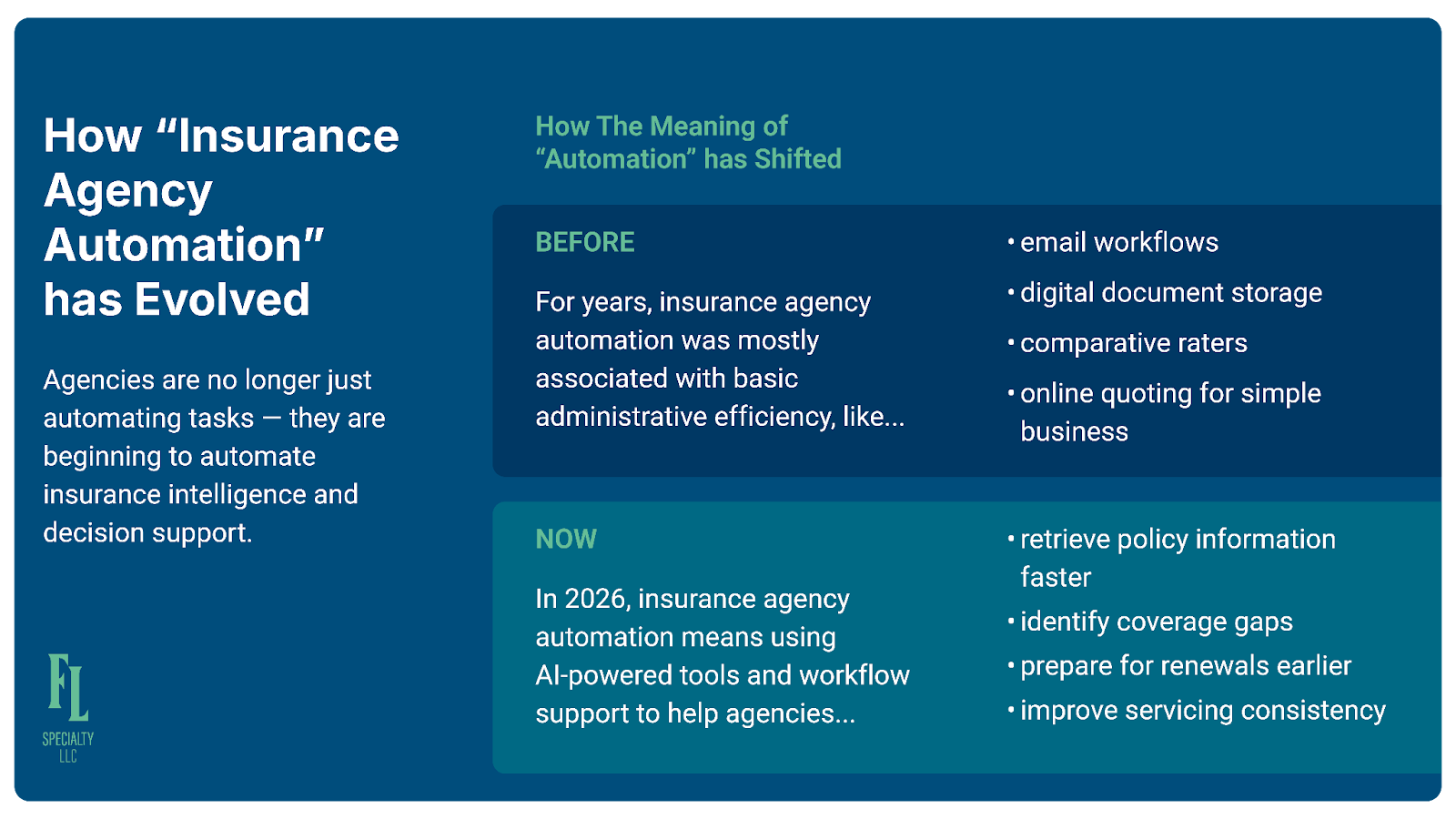
For years, insurance agency automation was mostly associated with basic administrative efficiency.
That included things like:
email workflows
digital document storage
comparative raters
online quoting for simple business
CRM task reminders
Those tools helped, but they did not solve the most important problem inside most agencies: too much time spent doing manual insurance work.
In 2026, insurance agency automation means something much more valuable. It means using AI-powered tools and workflow support to help agencies:
retrieve policy information faster
review policy documents more efficiently
identify coverage gaps
prepare for renewals earlier
improve servicing consistency
better understand a client’s insurance program
document coverage recommendations and client decisions in a consistent, defensible way
This is a meaningful shift. Agencies are no longer just automating tasks — they are beginning to automate insurance intelligence and decision support.
That distinction matters.
Because for lean teams, the real issue is not simply administrative burden. It is the amount of skilled staff time being consumed by repetitive policy review, fragmented information, and reactive servicing work — often without a clean record of what advice was given and how decisions were made.
Why Independent Insurance Agency Automation Matters Most for Lean Teams
Large brokerages can often absorb inefficiency with headcount. Lean agencies cannot.
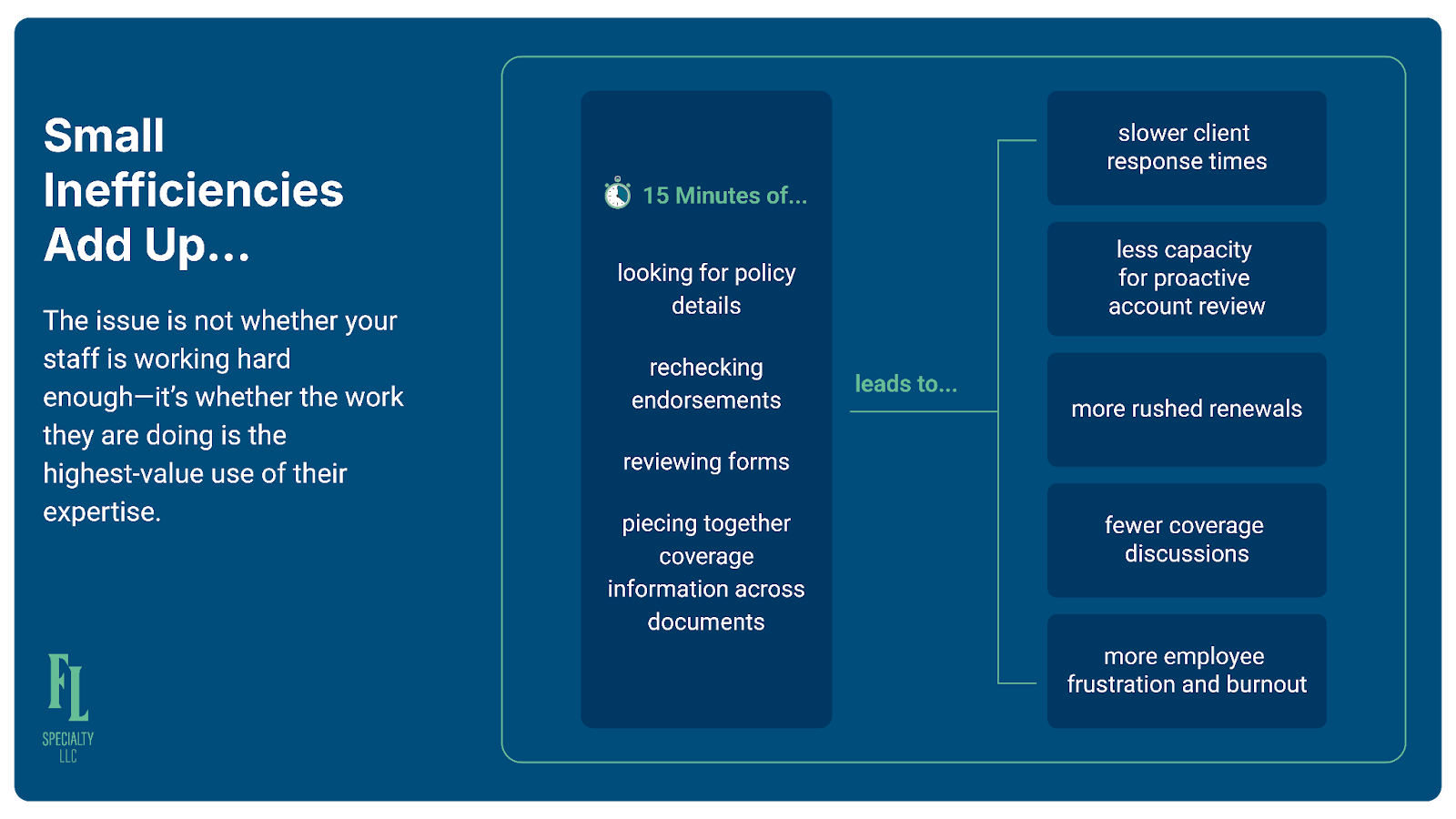
When a producer, account manager, or service team member spends 10–15 minutes looking for policy details, rechecking endorsements, reviewing forms, or piecing together coverage information across documents, that time compounds quickly.
Across a book of business, those small inefficiencies create major business consequences:
slower client response times
less capacity for proactive account review
more rushed renewals
fewer coverage discussions
more employee frustration and burnout
That is why insurance agency automation for lean teams matters so much.
The issue is not whether your staff is working hard enough. Most agency teams are already working at full capacity.
The issue is whether the work they are doing is the highest-value use of their expertise.
Too often, highly capable agency staff are spending their day:
searching for information
re-reviewing documents
manually answering routine policy questions
chasing down renewal details
reacting to client needs instead of anticipating them
And critically, doing this work without a structured way to:
track what coverage was recommended
document what options were presented
record when a client declines coverage
That is not just inefficient — it creates unnecessary exposure for the agency.
Automation introduces a more disciplined operating model where both service delivery and documentation improve together.
The Competitive Landscape Has Changed
The expectation gap for independent agencies is widening.
Clients do not compare your agency experience only to other insurance agencies anymore. They compare it to every fast, responsive, digitally enabled experience they have elsewhere.
At the same time:
regional firms are getting more operationally sophisticated
consolidators are improving efficiency through scale
commercial clients expect more strategic guidance
carrier ecosystems remain fragmented and inconsistent
For independent insurance agency automation to work, the competitive context has to be clear. And right now, the pressure is real. For many agencies, that creates a dangerous reality:
they are still operating with workflows built for a slower, simpler market.
Without insurance agency automation, lean teams often get trapped in a reactive cycle:
A client asks a question
The team searches for the answer manually
The answer takes longer than it should
The interaction becomes transactional instead of advisory
And just as importantly, there is often no clear audit trail of:
what advice was given
what options were presented
how the client ultimately decided
That model does not scale well, and it does not create meaningful differentiation — or protection.
How Top Agencies Use Insurance Agency Automation to Scale
The agencies getting the most value from automation are not necessarily the largest or most tech-heavy. They are simply more intentional about where they apply it.
They are using insurance agency automation tools to reduce repetitive work and improve the quality — and defensibility — of client-facing service.
That often includes:
policy intelligence that helps teams find answers quickly
AI-assisted policy review that improves consistency
coverage gap analysis that supports advisory conversations
renewal workflows that create earlier account engagement
client portfolio visibility that helps agencies manage accounts more strategically
structured documentation of coverage recommendations and client decisions
Leading agencies are also using automation to create:
consistent records of coverage options presented
documented evidence of client acceptance or declination
clearer internal visibility into account-level decisions
stronger audit trails to support E&O defensibility
The result is not just faster servicing. It is a more disciplined and professional operating model.
Instead of spending most of the day reacting, agencies can start creating more value through:
better coverage conversations
more proactive account reviews
stronger renewal strategy
more informed cross-sell and rounding opportunities
improved client trust
And importantly — clear documentation of how those outcomes were achieved.
Insurance Agency Automation Is About Leverage, Not Replacing People
One of the biggest misconceptions about automation is that it is primarily about replacing staff.
For most independent agencies, that is not the point.
The best insurance automation tools do not eliminate the need for experienced people. They eliminate the repetitive, low-value work that prevents experienced people from performing at their highest level.
They also provide structure around how advice is delivered and recorded.
That distinction matters because agencies do not win based on software alone. They win based on:
relationships
trust
advisory expertise
speed
responsiveness
consistency
And increasingly:
their ability to demonstrate what advice was given and why
Automation should strengthen those advantages, not dilute them.
For lean teams, the real value of automation is simple:
It allows a smaller team to operate with more precision, more consistency, more capacity — and better documentation — than their headcount would normally suggest.
What Happens If Agencies Wait Too Long
Many agencies know they need better operational leverage, but still delay action because:
current workflows feel “good enough”
implementing new technology feels disruptive
teams are already too busy to evaluate options
leadership assumes automation can wait until later
But in practice, waiting usually has its own cost.
Agencies that delay insurance agency automation often continue to absorb:
rising servicing burden
operational inefficiency
inconsistent documentation of client decisions
missed advisory opportunities
lower scalability
unnecessary pressure on team members
And over time, those hidden costs compound.
Insurance Agency Automation Is Now a Growth and Risk Decision
Independent insurance agency automation is no longer just an efficiency initiative — it is a growth and risk management decision.
The agencies that succeed in 2026 and beyond will be the ones that figure out how to:
serve clients faster
review policies more intelligently
reduce manual work
support lean teams more effectively
scale expertise without scaling overhead at the same rate
clearly document coverage recommendations and client decisions
That is the real opportunity.
The future does not belong only to the biggest agencies.
It belongs to the agencies that build smarter, more defensible operating models.
And increasingly, that starts with insurance agency automation.
Fall Line Specialty helps insurance organizations work smarter through practical AI-enabled solutions built for the realities of agency operations. With Agency Sidekick, lean teams can improve policy review, strengthen documentation, and deliver more proactive client service at scale.
Talk to us to learn how Fall Line Specialty and Agency Sidekick can help your agency operate with greater speed, consistency, and confidence.