AI for Insurance Agents: Empower Your Employees
AI for insurance agents isn’t about replacing producers or account managers. It’s about clearing out the low-value busywork that steals your day.
Because the truth is: most agencies don’t have a “lack of opportunity” problem. They have a time, follow-up, and workflow friction problem. Too many renewals, too many documents, too many client requests, and not enough clean hours to do the work that actually grows (and protects) the book.
This guide breaks down the most useful, real-world ways agents are using AI today, from renewal prep and loss runs to client service and book roll execution. Plus we’ll talk about how to implement it without turning your tech stack into a graveyard of “tools we tried once.”
Keep reading for the highest-impact use cases, the biggest adoption mistakes to avoid, and a simple way to get started in the next 90 days.
What “AI for Insurance Agents” Really Means (In Real Life)
Let’s simplify this fast: AI for insurance agents is software that helps you move information through your agency more efficiently.
That’s it. You’re not “becoming an AI agency.” You’re giving your producers and account managers better leverage. AI tools learn from language and data, which means they can handle routine processing, summarize messy information, and draft communication at scale—without you starting from scratch every time.
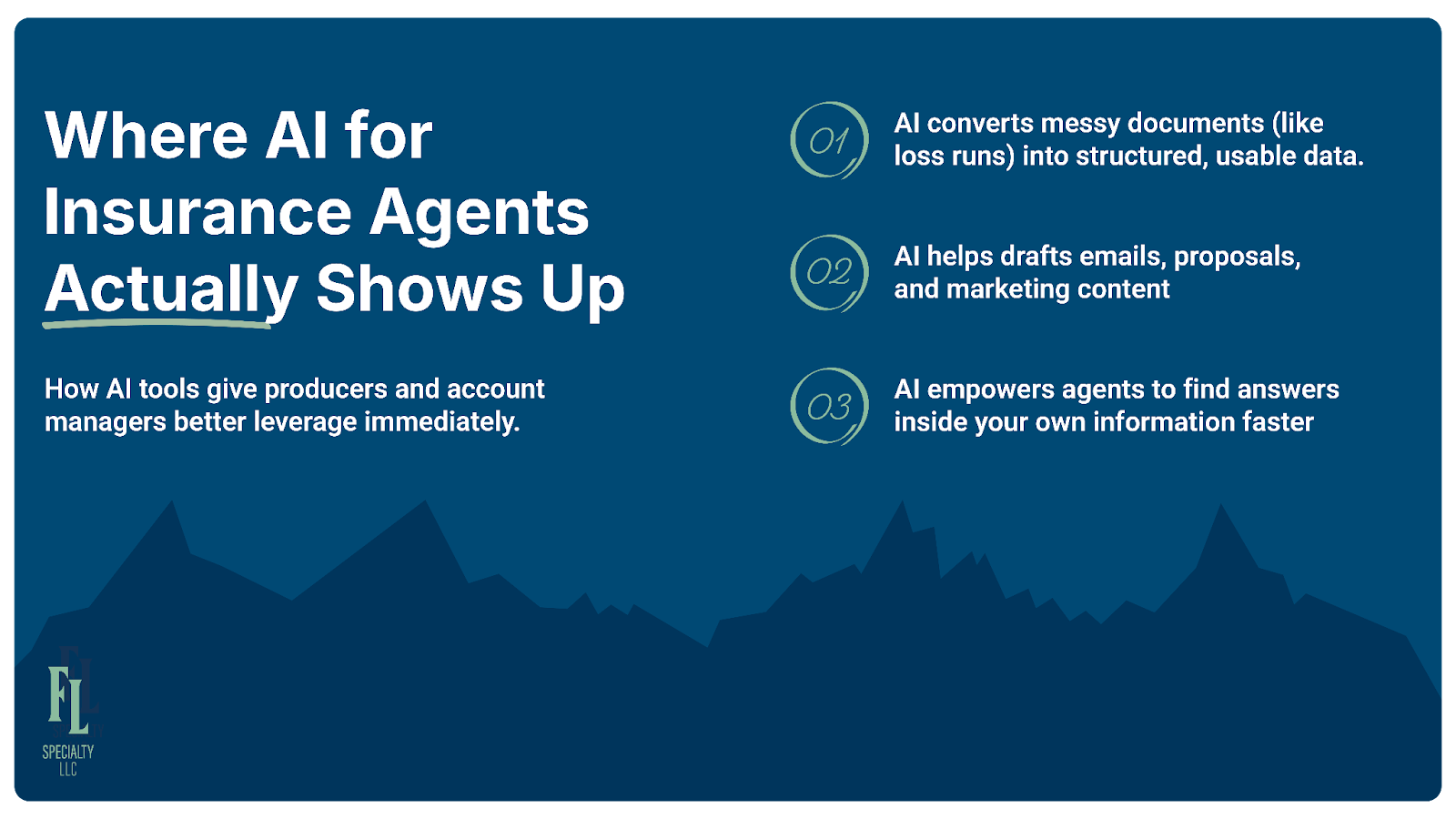
In a day-to-day sense, this usually shows up in three places first…
AI helps convert messy documents, such as loss runs, applications, and policy forms into structured, usable data.
It helps draft emails, proposals, renewal summaries, and marketing content so your team isn’t rewriting the same message all week.
It empowers you to find answers inside your own information faster, so you’re not digging through shared drives and PDF folders during live client conversations.
The point isn’t to “install AI” once and call it done. The point is to build momentum by layering AI into the workflows your team already lives in, one workflow at a time, until your agency feels lighter, faster, and more consistent.
If you want the full landscape, including key use cases for producers and account managers, stages of adoption, and the change management required to make it stick, read AI for Insurance Brokers and Agencies.
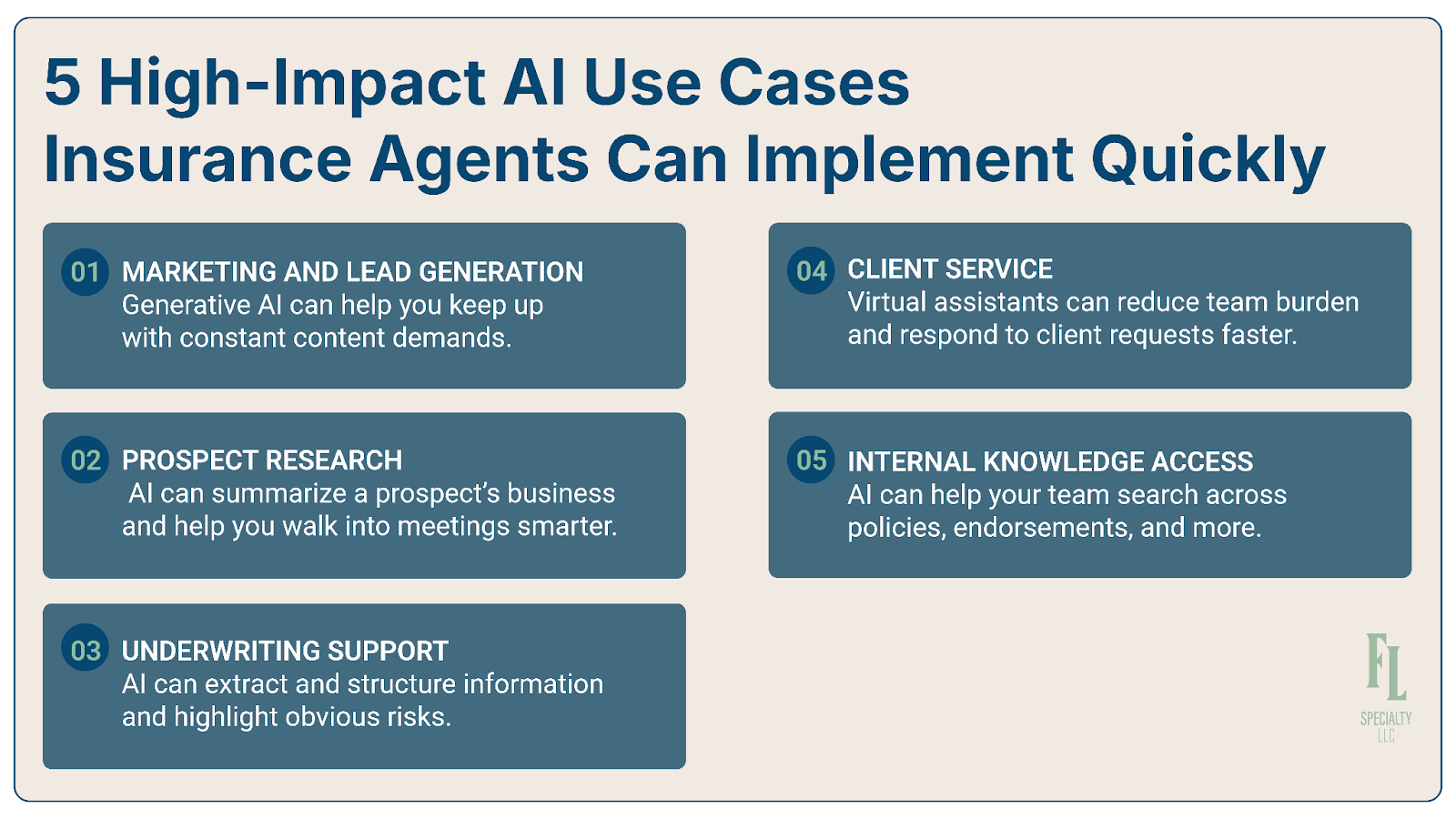
5 High-Impact AI Use Cases Insurance Agents Can Implement Quickly
When agencies think about AI, they often start with the wrong question. They ask, “What tools should we buy?” instead of asking, “Where are we leaking time every single week?”
The best AI wins in insurance come from repetitive workflows—the kind that happen daily, across every account manager’s desk, across every producer’s book. When AI hits those workflows, the time savings compound and the quality improves at the same time.
One of the biggest wins is marketing and lead generation. Generative AI can help you produce niche content, email campaigns, landing pages, and social posts without spending hours trying to sound “professional” while you’re also juggling renewals.
Another major win? Prospect research. AI can summarize a prospect’s business, pull key context, and help you walk into a first meeting with a sharper point of view.
On the underwriting side, AI can extract and structure information from submissions and supplemental forms, flag gaps, and highlight obvious risk indicators before you waste time sending incomplete information to markets.
Client service is another area where AI reduces drag. Virtual assistants can handle simple questions, route requests, and accelerate proof-of-insurance and certificate workflows without your team re-answering the same question thirty times.
Finally, internal knowledge access is an underrated power move. AI can help your team search across policies, endorsements, carrier memos, and past conversations instantly. That’s not just convenient. That’s how you stop losing time and confidence in the middle of client calls.
For a deeper breakdown of how these use cases show up differently for producers versus account managers (and how they evolve as agencies mature), readAI for Insurance Brokers and Agencies.
A Day in the Life: Loss Runs, Renewals, and Better Client Conversations
If you want to see the difference between “AI for insurance agents that’s interesting” and “AI for insurance agents that’s useful,” just take a look at loss runs.
Loss runs are one of the most common sources of friction in the agency workflow. They arrive in inconsistent formats, require manual cleanup, slow down renewal prep, snd they often force account managers to spend hours doing clerical work before a producer can even start to think strategically.
AI changes the workflow by making the information usable faster. Instead of manually keying loss data into spreadsheets, AI can ingest carrier loss runs, normalize fields, and produce summaries that tell you what’s actually happening in the account.
That shift matters because it upgrades renewal prep from data entry to decision-making. Your team can walk into renewal conversations ready to talk about trendlines, drivers of frequency, and what controls are realistic this policy term. Instead of a renewal meeting that feels like “here’s what the carrier did,” you get a renewal conversation that feels like “here’s what we’re doing next.”
And when clients feel guided, you don’t just retain accounts. You retain strong relationships.
If you want to see this workflow in action (and what it unlocks for renewal prep and client communication), check out our article Transforming Loss Run Reports & Management with AI.
Avoiding the “Power Tool Problem” With Insurance AI
Here’s the problem with AI for insurance agents: the tools usually work.
That sounds like a good thing—until every producer starts using different tools, every account manager has a different process, and your agency ends up with inconsistent workflows and zero visibility into what’s actually improving performance.
This is what we call the “power tool problem.” AI is like giving someone a nail gun. It’s powerful. It’s fast. But if you don’t use it with intention, you’re going to build something messy, unstable, and impossible to replicate.
The fix is not “use less AI.” The fix is to treat AI like you would a real operational change, the same way you’d approach adding a new CRM, rater, or AMS process. Start with one job to be done. Something measurable and repeated, like cutting loss run prep time in half or responding to all certificate requests same-day.
Then choose tools that fit into your existing systems, not tools that force your team to work in random side platforms. Finally, redesign the workflow around the tool. Decide who owns what, how outputs get reviewed, what quality looks like, and what metrics matter. That’s how AI becomes leverage instead of chaos.
For a deeper guide on tool selection, workflow redesign, and avoiding shiny-object syndrome, readThe Power Tool Problem: Making Insurance AI Tools Work for You.
Using AI for Insurance Agents to Execute Book Rolls and Protect Key Relationships
Book rolls are one of the most sensitive moves an insurance agent or agency can make. Done poorly, they create confusion, frustration, and relationship risk. Done well, they strengthen retention, improve outcomes, and prove your value as an advisor.
Book rolls get messy when agencies rely on memory, inboxes, and best intentions. AI reduces that chaos by turning the roll into a process instead of a scramble. It can help flag which accounts are good candidates based on loss performance, premium, renewal timelines, and carrier alignment—then support execution with consistent, client-friendly communication that clearly explains the move. Behind the scenes, it can create checklists and timelines for your team, so follow-ups don’t slip and accounts don’t get caught in limbo during a high-volume transition.
But the real advantage isn’t just automation. It’s confidence. When your process is documented and your messaging is clear, the roll becomes a coordinated agency initiative, not a scramble.
AI for insurance agents supports the execution, but the relationship is still the product. The agents who protect their book are the ones who communicate clearly, act early, and make clients feel guided instead of dragged along.
For a deeper strategy breakdown (and our FREE framework), readInsurance Book Roll Strategies: From Friction to Execution.
How to Get Started With AI for Insurance Agents (Without Overwhelm)
If you’re waiting until your agency has “the perfect AI strategy,” you’re going to wait forever.
The agencies that win with AI aren’t the ones with the biggest budgets. They’re the ones that start small, prove value fast, and standardize what works.
A simple way to begin is to run a 90-day pilot. Pick one workflow that happens constantly. Such as loss runs, renewal prep, prospect research, or certificate handling. Then, define what success looks like in plain terms, whether it’s time saved per account or faster response time.
Once you have your goals in mind, pilot with a small group: one producer and one account manager. Capture what works, refine the workflow, and document best practices. When the workflow feels repeatable, train the rest of the team and bake it into the systems you already use.
From there, expand into other use cases like marketing content, internal document search, and deeper analytics. You don’t need to boil the ocean. You need to remove friction, build confidence, and stack wins.
AI for insurance agents isn’t a futuristic play. It’s a workflow advantage you can build right now. Start with one high-friction process, prove the time savings, and standardize what works. The agencies that win won’t be the ones with the most tools—they’ll be the ones with the cleanest execution.