The Insurance Underwriting Process Gap That's Costing You Broker Relationships
Key takeaways
- 01 The insurance underwriting process breaks down not at the strategy level, but in the translation from leadership intent to frontline decisions — and most organizations don't realize it until broker relationships are already eroding.
- 02 Size doesn't determine execution quality — smaller firms move faster but lack infrastructure, while larger firms have the tools but struggle with bureaucratic drag. Both face the same alignment problem.
- 03 When brokers can't predict how submissions will be evaluated, they steer business elsewhere. Consistent execution is a retention tool, not just an operational one.
- 04 Technology alone doesn't close the gap — without intentional communication, training, and feedback loops, even the most advanced systems amplify misalignment rather than resolve it.
- 05 Closing the gap requires three things: articulating strategy into executable guidance, embedding it into daily workflows, and measuring alignment — not just outcomes.
In commercial property and casualty insurance, one of the most persistent challenges is aligning the insurance underwriting process with real-world execution: translating strategic intent into the consistent, frontline decisions that trading partners depend on.
This disconnect doesn’t just impact profitability, it erodes trust with trading partners and weakens competitive positioning in an increasingly demanding marketplace. The ability to execute a well-defined insurance underwriting strategy has become a core differentiator because a gap between intent and action puts long-term performance at risk.
The Complexity Challenge: Size Matters, But Not How You Think
The difficulty of connecting underwriting strategy with execution varies significantly by organizational size, but not always in the ways you'd expect.
Smaller firms tend to be nimble, adapting quickly to changing market conditions. But they often lack the data-driven infrastructure, automation, and underwriting resources needed to execute consistently across portfolios. Larger organizations, by contrast, have access to robust platforms and deep underwriting expertise, but often move slower due to bureaucratic complexity and legacy systems.
Clarity of underwriting appetite and direction is essential regardless of whether you’re operating as a carrier, MGA, broker, or agency². In today’s complex and competitive insurance environment, delivering quality service depends on everyone understanding what success looks like and how to achieve it.
For larger entities, connecting strategy and execution often requires major investments in technology, workflow integration, and organizational change management. These initiatives can take 18–24 months to implement and cost millions, with no guaranteed performance lift³. Smaller players face different constraints: limited funding for enterprise tools, leaner teams, and challenges scaling insurance underwriting operations in line with growth.
The result is a paradox. The players most equipped to execute sophisticated strategies often can’t move quickly enough, while the ones who can adapt quickly lack the infrastructure to execute comprehensively.
Building Trading Partner Confidence Through Consistent Execution
Insurance is, and always has been, a relationship-driven industry—and nothing tests those relationships faster than an inconsistent insurance underwriting process. Success hinges on trust: trust between carriers and reinsurers, MGAs and capacity providers, brokers and underwriters. And at the core of that trust is consistent execution.
When insurance underwriting strategies are well-defined but poorly implemented, inconsistency follows. That inconsistency erodes confidence, introduces unnecessary friction, and undermines even the most promising partnerships. Whether it’s fluctuating underwriting appetite, misaligned risk selection, or variable service levels, a lack of executional consistency signals unreliability to trading partners.
While McKinsey’s 2019 study on underwriting is now several years old, its insights remain relevant—and arguably even more critical in today’s market. The central takeaway? Sustainable competitive advantage stems not just from having a great strategy, but from executing that strategy consistently over time.⁴

The consequences of misalignment between underwriting strategy and execution are far from theoretical. Rather, they directly impact business performance. When trading partners can’t reliably predict how submissions will be evaluated or what a carrier’s true underwriting appetite entails, uncertainty replaces trust. Brokers may begin steering business elsewhere. Reinsurers may price uncertainty into their terms. Even internal teams can lose confidence, creating hesitation and missed opportunities. In a market where insurance underwriting success depends on clear, repeatable decisions, inconsistent execution quickly becomes a competitive liability.
The Measurement Imperative: Why the Insurance Underwriting Process Needs More Than General Direction
In today’s commercial insurance landscape, broad strategic vision is no longer enough, especially when it comes to insurance underwriting. Nowhere is this more evident than in the excess and surplus (E&S) lines market, where differentiation often hinges on deep domain expertise and niche appetite. But even in admitted lines, where underwriting targets may be broader, the specific nuances of execution determine the true shape and performance of a portfolio.
A PropertyCasualty360 analysis drives this point home:
“Commercial carriers sometimes fail to take the extra step to detail their business strategy into tangible resources that underwriters can use to make day-to-day underwriting decisions. Failing to recognize the importance in fleshing out high-level strategic directions prevents underwriters from accurately and consistently executing on the strategy.”5
This is why consistent measurement, and the ability to operationalize that measurement, is no longer optional. Consider a real-world example: a carrier launches a new liability product focused on the fast-growing but volatile marijuana industry. They define three tight underwriting boxes to guide eligibility. Within three months, submissions skyrocket even with a limited rollout. But premium growth lags expectations. A recent agent roundtable reveals mounting frustration. Meanwhile, the underwriting team is operating at full capacity.
Without the right metrics in place, the root cause remains hidden. The carrier may not realize:
Certain producers are submitting from states outside of underwriting appetite, due to unclear education.
Three offices are generating high volumes of off-target submissions, creating drag on underwriting efficiency.
New legislation has opened viable opportunities but without real-time monitoring, the team can’t pivot to seize them.
This is the crux of modern insurance underwriting success: aligning real-time insights with real-world performance. Measurement enables intentional, informed responses across the value chain. Without it, carriers remain stuck, being unable to distinguish whether performance issues stem from strategic misfires or poor execution.
The Modern Telephone Game: How Technology Fails the Insurance Underwriting Process
For all the advances in digital transformation, many insurance organizations still suffer from a surprisingly old-school problem: communication breakdown. Just like the game of telephone, strategic messages often get distorted as they move across departments, systems, and stakeholders, despite the layers of technology intended to ensure alignment.
This is especially true in insurance underwriting, where success depends on translating strategy into clear, consistent execution. Strategic intent must cascade into specific decision-making criteria, then be embedded in training programs, underwriting guidelines, decision-support tools, and core systems. But when even one link in that chain falters, clarity gives way to confusion.
As PropertyCasualty360 puts it:
“Underwriting guidelines, risk selection tools, pricing models, and escalation processes aim to embed the insurer’s underwriting strategy into day-to-day account decisions. However, underwriters also must have sufficient training to critically analyze accounts and use their judgment in conjunction with these tools and processes.”6
When this translation process fails, the result is inconsistent execution. One underwriter may interpret appetite guidance differently than another. Guidelines may be applied unevenly across territories or lines of business. Critical market feedback may take months to reach decision-makers, if it makes it there at all.
The takeaway? Technology is only as powerful as the alignment it supports. Without intentional communication, consistent training, and feedback loops, even the most advanced systems can amplify, rather than resolve, the disconnect between strategy and execution in insurance underwriting.
The Path Forward: Creating Alignment Through Structure
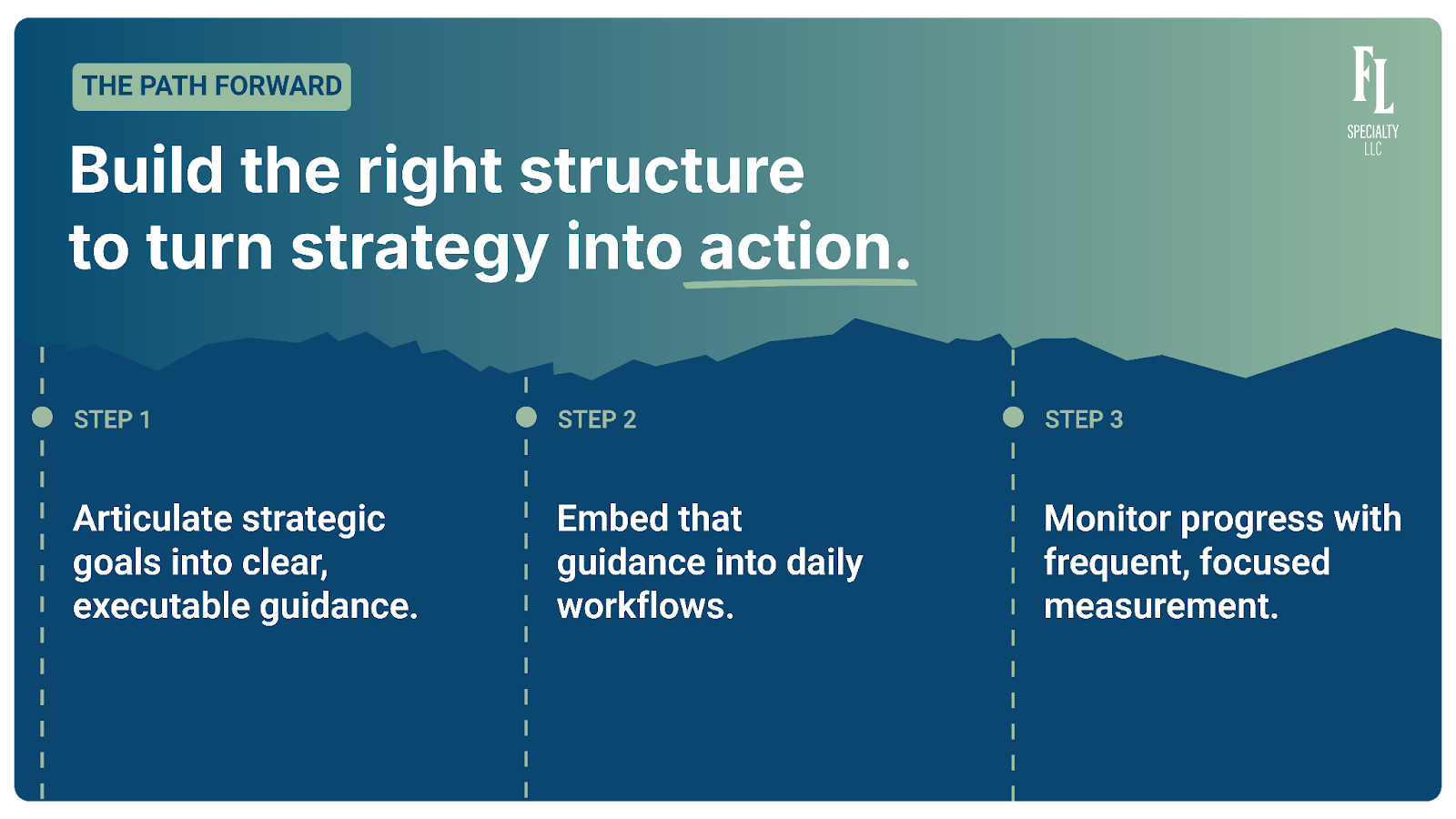
Connecting underwriting strategy with execution isn’t about more tools, it’s about building the right structure to turn strategy into action across your organization.
Articulate strategic goals into clear, executable guidance.
Translate high-level business objectives into actionable underwriting and marketing strategies. Front-line professionals need more than general direction, they need specific, practical instructions that account for the real-world complexity of insurance underwriting, especially in nuanced or ambiguous situations.
Embed that guidance into daily workflows.
Use training programs, decision-support tools, and escalation processes to bring strategy to life. With AI-driven tools becoming faster and more impactful, organizations must rethink traditional processes to fully capture these opportunities. Execution isn’t just about alignment. It’s about making strategy accessible at the point of decision.
Monitor progress with frequent, focused measurement.
Define KPIs that assess not just outcomes, but alignment. Ensure that underwriting decisions reflect the strategy behind them. Then act on those insights. In a fast-paced market, regular measurement is the only way to adapt, improve, and stay competitive.
In today’s evolving risk landscape, insurance underwriting performance hinges on your ability to align, activate, and adapt your strategy at scale and with speed.
Conclusion: Strategy Without Execution is Just Aspiration
The gap between strategy and execution is one of the most overlooked risks in the insurance underwriting process today. It’s also one of the greatest opportunities.
Insurers that bridge this gap, gain a sustainable edge built on clarity, consistency, and the ability to deliver on what they promise. Those that don’t, risk falling further behind in a marketplace that rewards precision and punishes unpredictability.
This isn’t just a technology problem. It’s an organizational one. Closing the gap requires a deliberate, structured approach: clear communication, actionable implementation, and continuous measurement. Above all, leadership needs to understand that having a strategy isn’t enough, but consistent execution will be what drives results.
In a relationship-driven industry like insurance, where confidence and consistency define success, carriers who align underwriting strategy with execution will build deeper trust, stronger partnerships, and long-term advantage. Those who don’t? They’ll remain stuck at the aspiration stage while the rest of the market moves forward.
Continue the conversation
Seeing this gap in your own organization?
Rob writes regularly on underwriting execution, AI, and the operational challenges facing carriers and MGAs. Connect on LinkedIn to follow along or start a conversation.
Connect with Rob on LinkedInRelated reading
Private Equity
Private Equity Insurance Roll-Ups: How AI Is Changing the Playbook
How the strategy-execution gap plays out specifically in PE-acquired MGAs — and what the best firms are doing differently.
Portfolio Management
Insurance Portfolio Management: The Clarity Risk Nobody Talks About
The same misalignment problem exists at the portfolio data level — and it's quietly distorting pricing assumptions and loss projections.
Agency Operations
AI for Insurance Brokers: What to Automate (and What Not To)
How automation can help brokers respond faster to the execution clarity their carrier partners are demanding.
Endnotes
McKinsey & Company. "From art to science: The future of underwriting in commercial P&C insurance." Insurance Practice, February 2019.
Joe Calandro, Jr., Katie Klutts, and Francois Ramette. "Underwriting from strategy to execution." PropertyCasualty360, October 21, 2015.
PwC Financial Services. "Commercial insurance underwriting strategy: The key to high performance." November 2018, page 2.
McKinsey & Company. "From art to science: The future of underwriting in commercial P&C insurance." Insurance Practice, February 2019, page 2.
Joe Calandro, Jr., Katie Klutts, and Francois Ramette. "Underwriting from strategy to execution." PropertyCasualty360, October 21, 2015, page 3.
Joe Calandro, Jr., Katie Klutts, and Francois Ramette. "Underwriting from strategy to execution." PropertyCasualty360, October 21, 2015, page 5.