
The Playbook for Portfolio Insurance Management: Why Fundamentals Still Win
It’s football season. I love football for a lot of reasons - the strategy, the teamwork, the precision under pressure. Every game is a balance of planning and execution, of reading the field and making adjustments in real time. But after years of watching, I’ve realized that what separates championship teams from the rest isn’t complexity, it’s consistency.
Every great play, drive, and season comes down to fundamentals: blocking, tackling, running clean routes, reading the defense. When each player executes their assignment with discipline, the team moves forward. The playbook might be sophisticated, but success depends on the basics, performed again and again with purpose.
The same is true in insurance. In a world chasing innovation and advanced analytics, the companies that consistently win are the ones that master the fundamentals of portfolio insurance management—the blocking and tackling of the business. Success doesn’t come from complexity; it comes from disciplined execution, consistent analysis, and the ability to turn insights into action.
The Leadership Parallel
Insurance organizations aren’t all that different from championship teams. With so many moving parts(risk selection, pricing, marketing, claims, compliance) the game can feel complex. But winning doesn’t come from piling on more tools or tech. It comes from consistent execution of the fundamentals.
Portfolio insurance analysis is one of those fundamentals. While it might sound like a high-end data science initiative, effective portfolio analysis doesn’t require machine learning models or custom dashboards. At its core, it's about asking sharp questions, measuring insurance portfolio performance, and adjusting based on what works. Consistently.
The best insights often come not from buying new tools, but from using the ones you already have, like Excel, more effectively. The organizations that get this right are the ones that focus on fundamentals, refine their questions, and revisit the results with discipline. They treat portfolio insurance as an active, evolving management practice, not a one-time reporting task.
Building a Discipline of Consistent Execution
Done right, portfolio insurance analysis isn’t a quarterly deck or one-off initiative. It’s a repeatable discipline that is an ongoing loop of analyzing, deciding, executing, and evaluating. Every cycle moves your organization closer to a stronger, more resilient insurance portfolio.
You don’t need cutting-edge analytics software or a room full of data scientists to do this well. You need a clear framework, consistent inputs, and the resolve to keep showing up to the process. When used regularly, simple tools and dependable data can reveal performance gaps and surface new growth levers.
That’s the real advantage. Winning insurance organizations don’t wait for perfect models or ideal market conditions. They work with what they have, move fast, and improve in every cycle. By treating portfolio insurance like a discipline, not a deliverable, they build resilience, edge, and long-term performance.
Why Fundamentals Aren't Easy (Even When They're Straightforward)
Let’s be clear: calling these techniques “fundamental” isn’t a dig. It doesn’t mean they’re simplistic or obvious. It means they’re essential, foundational, critical, and often the hardest to do well.
High-performing insurance organizations master fundamentals not because they’re easy, but because they treat them as non-negotiable. These are fast, practical analyses that don’t require machine learning or LLMs. They can be done with the tools you already have. But doing them well, and doing them consistently, is where the real challenge lies.
You need discipline. Domain expertise. Organizational buy-in. Because the true power of these fundamentals comes from their stacking effect:
Each analysis builds on the last.
Each insight leads to the next question.
Each action generates results that sharpen your understanding.
This compounds over time. It builds real momentum.
And in a world where everyone’s chasing “advanced AI,” that momentum becomes your edge. While others are still waiting on implementation, you’re generating insights, acting on them, and pulling ahead.
The Three Types of Portfolios (And Why This Matters to Everyone)
Before we go deeper, let's clarify what we mean by "portfolio" in the insurance context, because the principles apply across different business models:
Agent and Broker Portfolios: Every policy you place is part of a bigger picture. Analyze your book and you’ll uncover cross-sell opportunities, client segments with unmet needs, and carrier patterns that shape how you sell. Insurance portfolio analysis reveals the next best move.
Carrier Portfolios: Your book of business isn’t just about risk, it’s a data-rich asset. It holds signals on pricing precision, retention behavior, and agent performance. Smart carriers use this to refine appetite, shape distribution strategy, and boost profitability.
Aggregated Portfolios: For PE-backed consolidators and large insurance organizations managing multiple agencies or books of business, the stakes are even higher. Portfolio analysis helps you identify synergies, unlock efficiencies, and surface integration opportunities that transform overall performance.
Across all three, the formula is the same: Analyze consistently. Act decisively. Measure rigorously. Adjust intelligently. Repeat.
This cycle builds intelligence, and impact at scale.
The Cycle That Creates Competitive Advantage
Here's where portfolio management fundamentals become truly powerful: when you build them into a repeatable cycle that operates on a regular cadence like monthly, quarterly, or whatever frequency your business demands. The key isn’t just having insights. It’s building a system that translates those insights into action.
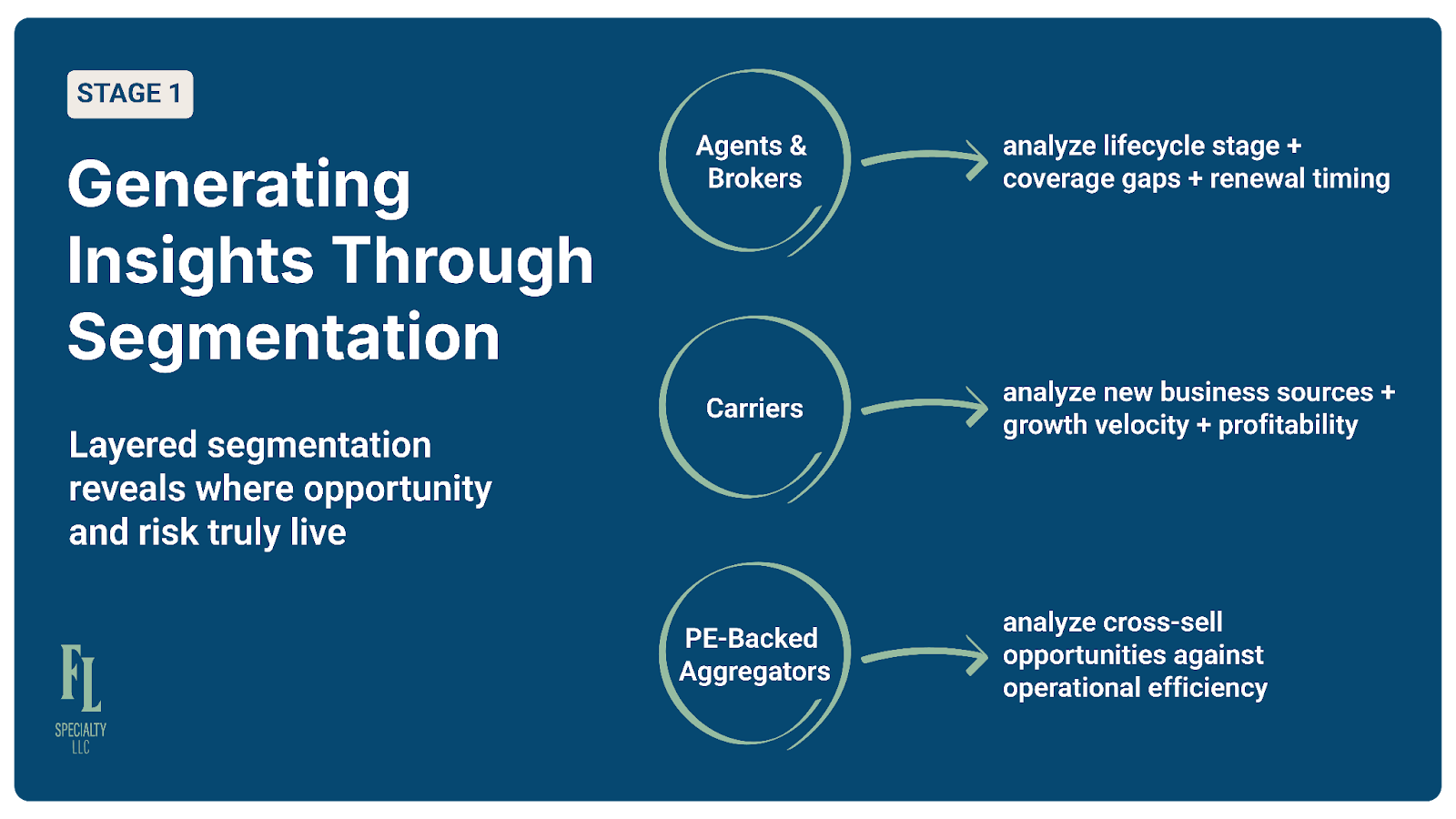
Stage 1: Generating Insights Through Segmentation
Strong leadership starts with a deeper understanding of your book. Not just surface-level demographics, but layered segmentation that reveals where opportunity and risk truly live.
Agents and brokers can analyze lifecycle stage + coverage gaps + renewal timing to surface cross-sell opportunities right before renewal. Or stack industry verticals with carrier mix and claims history to identify where they’re competitive, and where they’re not.
Carriers might analyze new business sources + growth velocity + profitability to uncover high-value distribution channels. Or segment agent production against loss ratios and retention to identify partnerships that create or destroy value.
PE-backed aggregators benefit from segmenting cross-sell opportunities against operational efficiency and integration progress to identify where consolidation creates more than just scale.
None of this is about randomly slicing data and hoping to get lucky. It’s about using insurance AI tools and simple portfolio analysis techniques to answer specific, business-critical questions. What are your best accounts? Where are you underperforming? What levers can you pull to shift performance?
The best insights come from focused inquiry, not fancier tools.
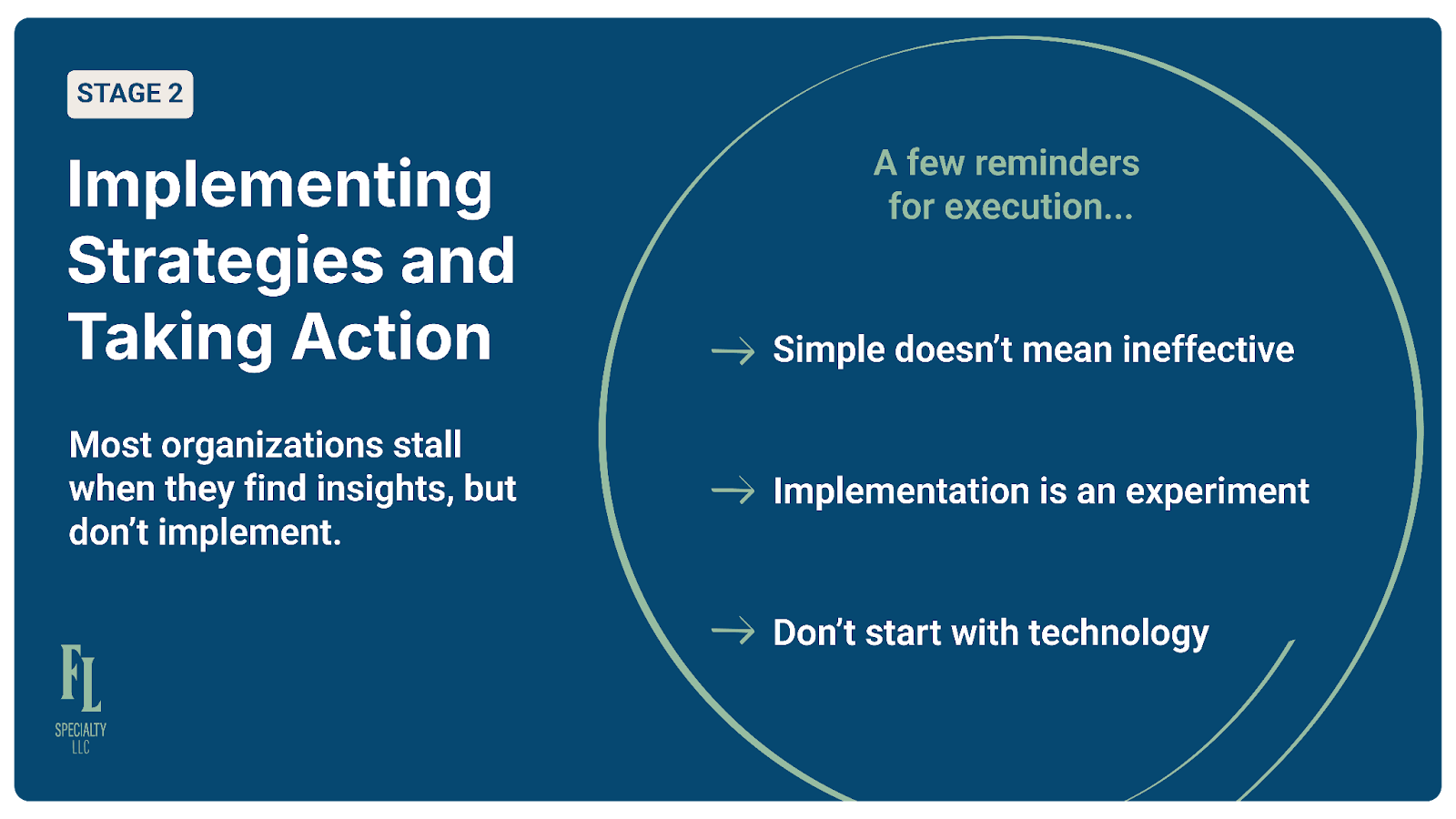
Stage 2: Implementing Strategies and Taking Action
This is where most organizations stall. They find insights, but don’t implement. A few reminders for execution:
Simple doesn’t mean ineffective. A manual process that works is more valuable than an automated system that never gets off the ground. Fast, scrappy implementation beats perfect but delayed execution.
Implementation is an experiment. Don’t treat early rollouts as permanent fixes. Use them to validate the insight, test results, and guide future investment.
Don’t start with technology. That may sound strange from a company that builds AI tools, but tech is only one part of the puzzle and often the most expensive part. Most insurance businesses already have the tools they need (even if that’s Excel). The advantage lies in how you use them, not in what platform you choose.
Start small. Move fast. Prove value. Then scale. That consistency builds execution muscle. It also creates a competitive edge: while others plan, you’re already acting. While others wait for software rollouts, you’re learning and improving.

Stage 3: Measuring Results to Inform the Next Round
This is what transforms one good initiative into a long-term capability: performance measurement that closes the loop and drives the next round of analysis.
Most teams spend time analyzing upfront, but very little time measuring outcomes. That’s a missed opportunity.
Track your primary KPIs, yes. But also measure adjacent metrics. Did your cyber campaign improve overall client retention? Did a producer bonus shift your business mix unexpectedly? The answers often lie in second-order effects.
This is how portfolio insurance analysis cycle becomes a continuous loop:
Measurement sparks new questions
Those questions drive segmentation
Segmentation leads to insight
Insights fuel action
Action generates results
And those results inform the next round
With each loop, your team sharpens its decision-making, builds capability, and moves closer to peak performance. It’s not just a one-time play. It’s a system for continuous improvement—and long-term competitive advantage.
Why Organizations Don't Execute This Consistently
If the fundamentals of portfolio insurance are so effective, why don’t more organizations follow them with discipline? We see four common blockers:
“Our data is too messy.”
Perfect data is a myth. What you need is data that’s good enough (roughly 80% clean) paired with the judgment to work around the gaps. You can’t wait for a pristine dataset to get started. At Fall Line, we help clients turn imperfect data into actionable insights that drive better portfolio insurance decisions. The question isn’t whether your data is flawless, it’s whether it’s strong enough to support smart action. The answer is usually yes.
“We don’t have time.”
This isn’t a bandwidth problem, it’s a prioritization problem. Strategic portfolio work often gets deprioritized in favor of reactive tasks. But portfolio insurance isn’t administrative work; it's a future-focused strategy. At Fall Line, we can handle the operational burden so your team can focus on leadership. Regardless of who executes, the return on time invested is unmatched.
“We need better systems first.”
Systems don’t think, but people do. Yes, modern systems can make portfolio insurance analysis faster and more scalable. But waiting for perfect infrastructure delays value creation. We’ve helped clients drive results using spreadsheets and scrappy tools, delivering measurable outcomes in weeks, not quarters. Get the insight first, leverage your team and expertise to get going, then let the tech follow.
“We lack analytical skills.”
This work is learnable. Many organizations assume they need advanced data science to unlock value, but the truth is, a lot of portfolio insurance strategy stems from knowing the business and asking the right questions. Start small. Or partner with a firm like Fall Line that combines analytical rigor with deep insurance knowledge. That combination is what separates tactical wins from lasting performance
When You're Ready for More Advanced Approaches
Once you’ve mastered the foundational cycles of portfolio insurance, there’s plenty of room to grow:
Pull in external data like economic indicators, competitive benchmarks, or market signals
Deploy predictive models to spot high-risk accounts before they lapse or underperform
Build real-time alerts and dashboards for ongoing portfolio performance
Optimize your portfolio to manage risk, growth, and retention simultaneously
Just don’t skip the basics.
Many teams jump to complex tools and AI-led strategies without ever building the core habits that make those efforts effective. They chase automation, but neglect insight. They build dashboards, but lack direction. Mastering portfolio insurance starts with execution, not infrastructure.
If you want compounding returns, build the muscle first, then scale.
Building Championship Organizations
Championship teams don’t win because of flashy playbooks—they win by executing fundamentals with discipline. Over time, that consistency becomes a competitive edge.
The same holds true in insurance. Success doesn’t come from exotic tech stacks or perfect conditions. It comes from understanding your portfolio, analyzing it consistently, and turning insight into action again and again.
If you commit to the fundamentals of portfolio insurance and execute them with rigor, you’ll build a high-performing organization that improves with every cycle. You’ll get faster at identifying risk, spotting opportunity, and adapting strategy. Those small, steady gains compound into a durable advantage.
At Fall Line, we help teams build that foundation. We bring a rare combination of insurance experience and analytical execution, so you can unlock value fast, often using the systems you already have.
You don’t need perfect data. You don’t need a new platform. You need a better rhythm.
Start with the blocking and tackling. Analyze your portfolio. Measure what matters. Adjust intelligently. Repeat consistently.
That’s how leaders win. That’s how you build something that lasts.
Next Up…
Turn portfolio fundamentals into a repeatable system that compounds performance over time.
Ready to build fundamental portfolio management capabilities that create competitive advantage? Fall Line Specialty helps insurance businesses execute the blocking and tackling that drives results. We combine insurance expertise with analytical rigor to deliver measurable outcomes in weeks, not months. Contact us to discuss how we can help your organization master the fundamentals.